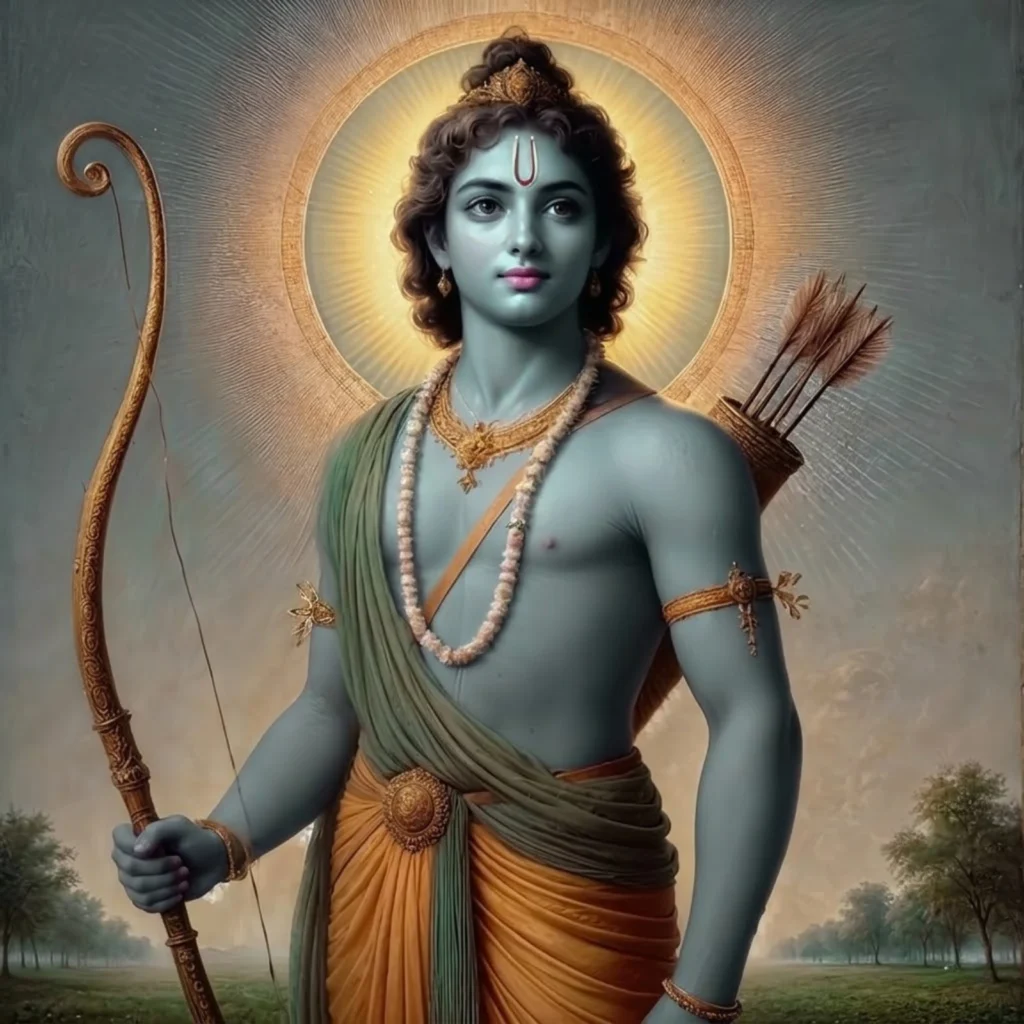
If you ask Indians across regions, religions, and backgrounds to name one figure who embodies ideal human conduct, most will answer: Lord Rama.
Not Shiva, though he’s revered. Not Krishna, though he’s beloved. Not even the Goddess, though she’s worshipped with fervor.
Rama.
Why? What makes this prince of Ayodhya who lived (according to traditional calculation) in Treta Yuga thousands of years ago still the reference point for ethical living in 21st-century India?
The answer lies in the title he’s universally known by: Maryada Purushottama literally, “the best of those who uphold boundaries/limits,” or more simply, “the Perfect Man.”
Rama’s story, told in the Ramayana (one of India’s two great epics), isn’t just mythology though as I’ve discussed throughout my work on what mythology actually means, that term itself is problematic. It’s more accurately Itihasa “it happened thus” sacred narrative that encodes ideal conduct.
Rama isn’t perfect because he never makes mistakes or faces no struggles. He’s perfect because he always chooses dharma (righteousness) even when it costs him everything: his throne, his wife, his happiness, his reputation.
Let me introduce you to this figure who has shaped Indian civilization for millennia not as hagiography, but as honest engagement with a complex character who remains profoundly relevant.
Who Is Lord Rama? The Basics
Lord Rama (राम) is the seventh avatar of Vishnu, born to establish dharma and destroy evil in Treta Yuga, the second of four cosmic ages.
Etymology
The name “Rama” comes from the Sanskrit root ram (रम्), meaning:
- To delight (he who brings joy)
- To rest (he who brings peace)
- To make happy (he who causes happiness)
He’s also called:
- Ramachandra (Beautiful as the moon)
- Dasharathi (Son of King Dasharatha)
- Raghava (Descendant of King Raghu)
- Maryada Purushottama (The Perfect Man who upholds limits)
The Ramayana: Rama’s Story
Rama’s life is told primarily in the Ramayana, composed by sage Valmiki around 500 BCE to 100 BCE. At nearly 24,000 verses, it’s one of the longest epic poems in world literature.
The Ramayana has been retold countless times:
- Ramcharitmanas by Tulsidas (16th century, in Hindi)
- Ramavataram by Kamban (12th century, in Tamil)
- Regional versions in every major Indian language
- Adaptations across Southeast Asia (Thailand, Indonesia, Cambodia, Laos)
Each version emphasizes different aspects, but all center on Rama as the embodiment of dharma.
The Story: A Prince’s Journey Through Loss, Exile, War, and Victory
Let me give you the essential narrative (simplified, as the full Ramayana could fill libraries):
Birth and Youth
Rama was born in Ayodhya to King Dasharatha and Queen Kausalya. He had three brothers: Lakshmana, Bharata, and Shatrughna.
From childhood, Rama excelled in archery, scholarship, and all princely virtues. As a young man, he won Sita’s hand in marriage by stringing the impossible bow of Shiva a feat no other prince could accomplish.
They returned to Ayodhya, and Rama was set to be crowned king (yuvaraja). Everything was perfect.
The Exile
Then came the crisis that defines Rama’s character.
King Dasharatha’s youngest wife, Kaikeyi, had once saved the king’s life in battle. In gratitude, he’d promised her two boons any wishes she desired.
Years later, manipulated by her maid, Kaikeyi demands:
- Her son Bharata be crowned king instead of Rama
- Rama be exiled to the forest for fourteen years
Dasharatha is devastated. He begs her to reconsider. But a king’s word is sacred. He cannot break his promise.
Here’s where Rama shows his character.
He has every right to refuse. The boons were given to Kaikeyi, not extracted from him. He’s the rightful heir. The people want him. Even Kaikeyi’s son Bharata doesn’t want the throne.
But Rama says: “Father has given his word. A king must keep his promises. I will go to the forest.”
Just like that. No anger. No resentment. No political maneuvering.
He gives up the throne, puts on bark clothes, and walks into exile.
Sita refuses to stay behind: “A wife’s dharma is to be at her husband’s side.” Lakshmana refuses too: “A brother’s dharma is to support his brother.”
So all three prince, princess, and prince walk into the forest to live as ascetics for fourteen years.
Life in Exile
The forest exile isn’t peaceful retreat. It’s dangerous territory:
- Demons (rakshasas) attack sages in their meditation
- Wild animals threaten constantly
- Harsh conditions test endurance
Rama protects the sages, defeats demons, and lives with quiet dignity. He makes alliances: with Guha (tribal chieftain), Shabari (low-caste devotee), and eventually Sugriva (vanara/monkey king).
For thirteen years, they manage.
The Abduction
Then Ravana the ten-headed demon king of Lanka hears of Sita’s beauty.
He tricks Rama away from their hut, assumes the form of a wandering ascetic, and abducts Sita, carrying her to his island kingdom.
Rama is devastated. For the only time in the epic, we see him lose composure he grieves wildly, accuses the forest of hiding his wife, nearly loses his sanity.
But he recovers. And he begins the impossible task: crossing the ocean to Lanka, defeating Ravana’s army, and rescuing Sita.
The Alliance and the War
Rama doesn’t have an army. He’s an exiled prince with one brother.
But he forms an alliance with Sugriva’s vanara (monkey/bear) kingdom. Hanuman the greatest devotee and warrior leads the search for Sita.
They find her. They build a bridge across the ocean (with the help of millions of vanaras and even a squirrel whose small contribution Rama blesses). They cross to Lanka.
The war is brutal. Ravana is nearly invincible he has divine boons, immense power, mastery of sorcery. But Rama, with righteousness on his side and Hanuman’s devotion, finally defeats him.
Sita is rescued. The fourteen years are complete.
The Return and the Tragedy
They return to Ayodhya. Rama is crowned king. This should be the happy ending.
But then comes the most controversial part of the Ramayana.
People in the kingdom whisper doubts about Sita’s purity she lived in another man’s kingdom for months. Though she’d proven her purity through a fire test (Agni-pariksha), rumors persist.
Rama, as king, faces an impossible choice: uphold personal love or uphold public dharma.
He chooses dharma. He banishes Sita who is pregnant to the forest.
This breaks him. But he does it because a king must be above reproach, must honor his subjects’ concerns even when unjust.
Sita gives birth to twin sons, Lava and Kusha, who grow up in Valmiki’s ashram. Eventually, they confront Rama, singing the Ramayana itself. Rama realizes his sons have been raised by Valmiki.
In different versions, the ending varies:
- Sita returns to Mother Earth (since she’s Earth’s daughter)
- Rama eventually joins her in the divine realm
- His rule (Ram-rajya) becomes the standard for ideal governance
Why Rama Is Called Maryada Purushottama (The Perfect Man)
“Maryada” means boundary, limit, propriety. “Purushottama” means best of persons.
Rama is “perfect” not because he’s without struggle, but because he always operates within proper boundaries he never violates dharma, even when it costs him everything.
The Ideal Son
When Kaikeyi demands his exile, Rama doesn’t argue, doesn’t manipulate, doesn’t rebel.
He says: “Father has given his word. A son’s dharma is to obey.”
Even though obeying means giving up his rightful throne and living in poverty.
The Ideal Husband
When Sita insists on accompanying him to exile, he initially refuses why should she suffer?
But she invokes her dharma as wife: “My place is at your side, in joy and suffering.”
He accepts. And throughout their ordeal, he treats her as equal partner, not possession.
Even when he later banishes her (the most controversial act), it’s not from lack of love but from duty to kingship.
The Ideal Brother
Lakshmana accompanies Rama into exile out of devotion. For fourteen years, he serves Rama selflessly.
And Rama, in turn, treats Lakshmana not as servant but as beloved companion. Their relationship models what brotherhood should be: mutual respect, sacrifice, love.
When Bharata comes to the forest and begs Rama to return and claim the throne, Rama refuses but not out of stubbornness. He refuses because he won’t violate his father’s word, even though his father is dead.
Bharata then rules as regent, placing Rama’s sandals on the throne as symbol of Rama’s legitimate authority. Every day, Bharata treats the sandals with reverence, ruling only in Rama’s name.
This is dharma: each brother fulfilling his role perfectly.
The Ideal Friend
Rama’s friendships show his character:
- Hanuman: Rama recognizes Hanuman’s devotion and treats him as equal, not subordinate
- Sugriva: Rama helps Sugriva reclaim his kingdom from Vali, establishing trust
- Vibhishana: When Ravana’s own brother defects to Rama’s side, Rama accepts him despite his lineage
Rama judges people by character, not by birth or circumstances.
The Ideal King
After his coronation, Rama’s rule called Ram-rajya becomes the standard for ideal governance.
What made it ideal?
- Justice: Everyone equal before the law
- Prosperity: The kingdom flourished economically
- Peace: No crime, no war, harmony
- Dharma: Everyone fulfilled their role appropriately
- Accessibility: Rama listened to all subjects, even a washerman whose gossip led to Sita’s exile
Ram-rajya became such a powerful symbol that Mahatma Gandhi said his dream for India was to establish Ram-rajya not theocracy, but a state where governance serves dharma.
The Ethical Dilemmas: Why Rama Remains Relevant
What makes Rama interesting philosophically is that he faces genuinely difficult ethical questions with no clean answers.
Can You Uphold Dharma and Personal Happiness Simultaneously?
Rama chooses dharma over happiness repeatedly:
- Gives up throne (dharma to father) over becoming king (personal ambition)
- Banishes Sita (dharma to subjects) over keeping his wife (personal love)
- Kills Vali from behind a tree (controversial strategy) to keep his promise to Sugriva
These aren’t easy choices. They’re tragic. But Rama chooses what he believes is right, even when it destroys him personally.
Is Absolute Adherence to Rules Always Right?
Some scholars criticize Rama’s banishment of Sita as unjust she did nothing wrong, so why punish her for rumors?
This is a real ethical question. Was Rama right to prioritize public perception over his wife’s dignity?
Different readers answer differently. But the Ramayana doesn’t hide the complexity it shows Rama’s suffering, shows Sita’s pain, leaves us to wrestle with whether this was truly dharma or a tragic error.
That’s what makes it valuable. It’s not propaganda. It’s a text that presents ideals while acknowledging their costs.
Can You Use Questionable Means for Righteous Ends?
When Rama fights Vali (Sugriva’s brother), he shoots Vali from behind a tree not face-to-face combat.
Vali, dying, accuses Rama of violating kshatriya (warrior) dharma: “You hid and shot me. Where’s the honor?”
Rama responds: “You stole your brother’s wife and kingdom. You violated dharma first. I acted as judge, not warrior.”
Is Rama right? Or is this rationalization?
The text lets us decide.
Rama in Practice: How Indians Engage His Story
Rama isn’t just a character in a book. He’s a living presence in Indian religious and cultural life:
Ramayana Recitations
The Ramayana is recited publicly during:
- Ram Navami (Rama’s birthday) in March-April
- Dussehra/Vijayadashami (celebrating Rama’s victory over Ravana) in September-October
- Daily readings in temples and homes
Tulsidas’s Ramcharitmanas is so popular that many Hindus can recite verses from memory.
Ram Lila Performances
Ram Lila dramatic enactments of the Ramayana are performed across North India in the weeks before Dussehra.
Children and adults gather to watch actors portray Rama, Sita, Lakshmana, Hanuman, and Ravana. The performances can last hours, even days.
On Dussehra, massive effigies of Ravana are burned, symbolizing the victory of good over evil.
Devotional Practices
Devotees chant:
- “Jai Siya Ram” (Victory to Sita and Rama)
- “Jai Shri Ram” (Victory to Lord Rama)
- “Sita Ram” (simply invoking both names together)
These aren’t just ritual. They’re expressions of aspiration: to be like Rama, to live with his integrity.
Some devotees like the Ramnami community in Chhattisgarh tattoo “Ram” across their entire bodies as ultimate devotion.
What Rama Teaches Today
Even if you’re not Hindu, Rama offers profound lessons:
Integrity Is Costly
Rama loses everything throne, wife, comfort, reputation because he won’t compromise dharma.
In a world that says “be flexible,” “do what works,” “the ends justify the means,” Rama says: No. Some principles are worth any cost.
That’s uncomfortable. But it’s why he remains compelling.
Leadership Means Service
Rama, despite being divine incarnation and rightful king, never lords his power over others.
He helps a squirrel build the bridge. He accepts Vibhishana despite others’ doubts. He listens to a washerman’s opinion even though it leads to personal tragedy.
Real power, Rama demonstrates, serves others.
Suffering Can Be Noble
Rama’s exile, his loss of Sita, his lonely rule after banishing her these aren’t failures. They’re sacrifices for larger good.
Modern culture often frames suffering as something to avoid or fix. Rama suggests: Sometimes suffering is the price of doing right. And that doesn’t make it meaningless it makes it noble.
Family Roles Matter (But Can Be Questioned)
The Ramayana emphasizes dharma based on role: son, brother, husband, king.
This can be read conservatively (everyone stay in your place) or progressively (fulfill your role with excellence).
But it also allows questioning: Was Rama right to prioritize king-role over husband-role? Different readers answer differently, and that’s okay.
The text doesn’t shut down critique. It invites it.
Rama and Problematic Readings
I’d be dishonest if I didn’t acknowledge controversies:
The Banishment of Sita
Many feminists rightly critique Rama’s banishment of pregnant Sita as patriarchal injustice.
Sita did nothing wrong. She endured captivity with dignity. Yet she’s punished for rumors.
Some readings defend Rama: he’s torn between personal love and public duty, and tragically chooses duty.
Others condemn him: no truly righteous person would prioritize reputation over justice.
Both readings are valid. And importantly, the Ramayana itself shows Rama’s suffering over this choice it doesn’t present it as obviously correct.
Political Weaponization
In contemporary India, “Jai Shri Ram” has been weaponized politically, sometimes used by mobs committing violence against minorities.
This isn’t Rama’s fault. But it’s worth noting: sacred narratives can be misused.
As I’ve explored throughout my work on mythology, the frameworks we use matter. When Rama is deployed to justify violence or oppression, that’s perversion of his actual teaching.
The real Rama models restraint, justice, compassion not mob rule.
Caste and Hierarchy
The Ramayana reflects its historical context, including caste hierarchy. Some passages are used to justify caste discrimination.
Critical engagement with the text means acknowledging these elements while not reducing the entire narrative to them.
We can learn from Rama’s ethical struggles while rejecting social hierarchies the text takes for granted.
Conclusion: The Hero India Still Needs
Rama was according to tradition born thousands of years ago in Treta Yuga, ruled Ayodhya in a golden age, and eventually returned to his divine realm.
But he never left.
Walk through any Indian town, and you’ll find:
- Rama temples
- Streets named “Ram Nagar”
- Shops called “Jai Shri Ram”
- Children named Rama, Sita, Lakshmana
- Stories told by grandparents
- Festivals celebrated annually
Rama endures because the questions he faced remain:
- How do you balance duty and desire?
- When should you compromise, and when should you stand firm?
- What does it mean to lead with integrity?
- How do you maintain character when it costs everything?
These aren’t ancient questions. They’re today’s questions.
And while Rama doesn’t provide easy answers, he provides something more valuable: a model of someone who faced these questions and chose dharma every time, regardless of cost.
Whether that makes him admirable or tragically mistaken is something each reader decides.
But his endurance as India’s ideal suggests that somewhere, deep in the cultural consciousness, there’s recognition: This is what integrity looks like. This is what it costs. This is why it matters.
As Swami Vivekananda said: “Rama is the embodiment of truth, of morality, the ideal son, the ideal husband, and above all, the ideal king.”
Not because life is simple. But because even when life is impossibly complex, some people still choose right.
And that possibility that humans can aspire to be better, can choose dharma even when it destroys them that’s why Rama matters.
Jai Siya Ram.
Frequently Asked Questions
Lord Rama is the seventh incarnation of Vishnu, born in Ayodhya to King Dasharatha and Queen Kausalya. His life is preserved in the Ramayana, where he is portrayed as the embodiment of dharma, or righteous conduct. He is revered not for supernatural power alone but for his unwavering commitment to moral responsibility in every role he occupies. Whether as a son, husband, warrior, or king, Rama consistently chooses duty over personal desire. This consistency earned him the title Maryada Purushottama, the ideal human being. For devotees, he represents a living model of integrity, discipline, and ethical clarity.
The Ramayana follows the life of Prince Rama, whose exile from Ayodhya begins due to palace intrigue involving his stepmother Kaikeyi. Accepting exile to honor his father’s promise, he departs with Sita and Lakshmana into the forest. The story intensifies when Ravana, the king of Lanka, abducts Sita through deception. Rama forms alliances with the vanaras, including Hanuman, to rescue her. After a decisive war in Lanka, Ravana is defeated and Sita is recovered. Rama returns to Ayodhya after fourteen years and ascends the throne, establishing a reign remembered for justice and balance.
The title Maryada Purushottama signifies the highest ideal of a person who never crosses ethical boundaries. Rama earns this distinction by consistently choosing what is right over what is easy or personally beneficial. He accepts exile without protest, upholds truth even at great loss, and governs with strict adherence to moral responsibility. His decisions often involve deep personal sacrifice, yet he never deviates from dharma. The title reflects not perfection in ease, but perfection in conduct under pressure. It marks him as a standard against which human character is measured.
Dharma in the Ramayana refers to the responsibilities and ethical duties tied to one’s role in life. It is not fixed but shifts according to context, whether as a son, king, or warrior. Rama’s life illustrates how these duties often conflict, requiring difficult choices. He honors his father’s promise as a son, protects Sita as a husband, and upholds justice as a king. His decisions show that dharma is not about convenience but about alignment with moral truth. Rama’s example demonstrates that living dharma requires clarity, discipline, and sacrifice.
After returning to Ayodhya, public doubt arose regarding Sita’s purity despite her trial by fire proving her innocence. Rama faced a conflict between personal truth and public perception as a ruler. Choosing to preserve the moral authority of the throne, he exiled Sita, even though he believed in her completely. This decision reflects the extreme demands of kingship as portrayed in the epic. It has remained one of the most debated aspects of his life. The narrative presents it not as a simple act, but as a deeply painful and morally complex choice.
Ram Rajya refers to the idealized reign of Rama in Ayodhya, marked by justice, prosperity, and social harmony. It represents a state where governance is rooted in ethical responsibility rather than power. In this vision, rulers serve the people, and no individual suffers from injustice or neglect. The concept has influenced political and philosophical thought for centuries. It was later invoked by leaders like Mahatma Gandhi as a model for ethical governance. At its core, it symbolizes the alignment of power with righteousness.
The relationship between Rama and Hanuman exemplifies the ideal of devotion and divine reciprocity. Hanuman serves Rama with complete loyalty, performing extraordinary feats without expectation of reward. His devotion is rooted in love, humility, and unwavering faith. Rama, in turn, recognizes and honors Hanuman not as a servant but as a trusted companion. This mutual respect elevates their bond beyond hierarchy. Spiritually, it represents the connection between the devotee and the divine, where sincere devotion is met with grace.
The Ramayana presents leadership as a burden defined by responsibility rather than privilege. Rama consistently places the welfare of his people above his own desires. He accepts exile, wages war for justice, and makes personal sacrifices to uphold public trust. His leadership is marked by accountability, restraint, and moral clarity. The text emphasizes that true authority comes from ethical conduct, not force. It portrays leadership as a test of character, where decisions are guided by duty rather than personal gain.
Rama is worshipped through devotional practices such as chanting his name, observing festivals like Ram Navami and Dussehra, and reciting sacred texts like the Ramcharitmanas. His presence is deeply woven into cultural and spiritual life across India. For many, he is a divine figure whose story carries sacred authority. Others engage with the Ramayana as a literary and philosophical text without religious belief. Both approaches coexist within the broader tradition. This flexibility allows the narrative to remain relevant across different perspectives and generations.
Rama’s life teaches that integrity is defined by choices made under pressure, not in comfort. He demonstrates that duty often requires sacrifice and that ethical clarity must guide action. His example shows the importance of patience, resilience, and commitment to truth. In a world of competing interests, his life underscores the value of responsibility over convenience. His decisions are not always easy or universally accepted, which makes them worth examining. This complexity keeps his story relevant for those seeking guidance in moral and leadership challenges.
Continue Your Journey

About the Author
Priyanka Sharma Kaintura
Priyanka Sharma Kaintura is a mythology activist, author, and speaker dedicated to excavating narratives that have been buried by patriarchy and colonialism, while engaging critically with sacred texts. After two decades in corporate communication, she now writes full-time, exploring how ancient narratives address contemporary questions about ethics, power, and meaning.
Her books include Mahadevi: The Unseen Truth Behind Existence and My Jiffies: Narration of Moments, Unadulterated and Unpackaged.


