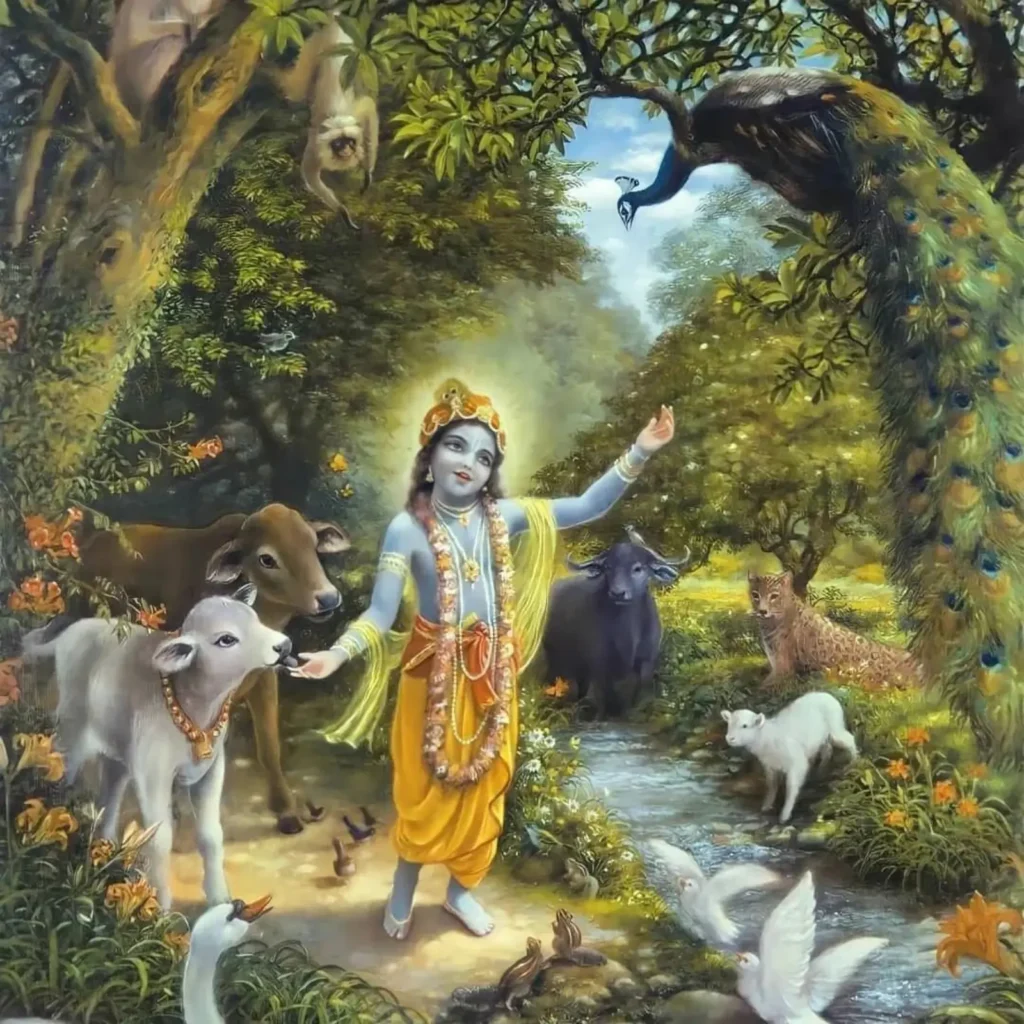
If you ask which Hindu deity is most beloved globally, not just worshipped, but loved with personal intimacy the answer is clear: Krishna.
Not Rama, though he’s revered for righteousness. Not Shiva, though he’s powerful. Not even the Goddess, though she’s fiercely adored.
Krishna.
Why? What makes this blue-skinned cowherd butter thief, flute player, dancer with milkmaids, battlefield strategist, cosmic teacher the deity millions call “my Kanha,” “my friend,” “my everything”?
The answer lies in a Sanskrit word: Leela (लीला) divine play.
Unlike Rama, who embodies dharma through sacrifice, Krishna embodies it through play. He’s not solemn. He’s joyful. He steals butter and gets caught on purpose. He dances all night with cowherd women. He plays the flute that makes rivers stop flowing and peacocks dance.
And yet this playful god is also:
- The teacher of the Bhagavad Gita, the most influential philosophical text in Hinduism
- The master strategist who wins the Mahabharata war without fighting
- The eighth avatar of Vishnu, who descends to restore cosmic order
- The beloved of Radha in the most profound spiritual romance ever told
As I’ve explored throughout my work on mythology, sacred narratives work on multiple levels. Krishna operates on ALL of them simultaneously: child, lover, friend, teacher, king, god.
Let me introduce you to this infinitely complex, impossibly attractive, utterly human and completely divine figure.
Who Is Krishna? The Basics
Lord Krishna (कृष्ण) is the eighth avatar of Vishnu, born in the Dwapara Yuga to destroy evil and establish dharma.
Etymology
“Krishna” (कृष्ण) means:
- Dark or black (his skin color, usually depicted as blue)
- All-attractive (one who draws all beings)
- The one who ploughs (the field of karma)
He’s also called:
- Govinda (protector of cows, also “one who gives pleasure to the senses”)
- Madhava (descendant of Madhu)
- Vasudeva (son of Vasudeva)
- Kanha (term of endearment)
- Gopala (cowherd)
Krishna’s Story
Krishna’s life is told across multiple texts:
- Bhagavata Purana (especially Book 10 his childhood and youth)
- Mahabharata (his role in the great war)
- Bhagavad Gita (his teaching to Arjuna)
- Countless regional retellings, devotional poetry, and artistic traditions
His life spans 125 years (according to tradition) and includes:
- Miraculous birth in prison
- Childhood in Vrindavan (butter stealing, demon slaying)
- Youth (Raas Leela, Radha’s love)
- Adulthood in Dwarka (kingship, multiple marriages)
- Role in Mahabharata (charioteer, teacher, strategist)
- Final departure from the world
Each phase reveals different dimensions of divinity.
The Birth: Divine Plan in Motion
Krishna was born to Devaki and Vasudeva both imprisoned by Devaki’s brother, the tyrant King Kamsa of Mathura.
Why imprisoned? A prophecy declared Devaki’s eighth son would kill Kamsa.
So Kamsa killed each child as it was born. One. Two. Three. Six children murdered before their parents’ eyes.
On the eighth pregnancy, Krishna was born at midnight. Divine intervention:
- Chains broke
- Guards fell asleep
- Prison doors opened
- The Yamuna River parted
Vasudeva carried baby Krishna across the flooded river to Gokul, swapping him with a newborn girl (who was Yogmaya, the Goddess in disguise).
When Kamsa tried to kill the girl, she flew into the sky and warned: “Your killer lives elsewhere.”
Symbolism: From birth, Krishna’s life is leela divine play that looks like escape but is really cosmic choreography. He’s not fleeing danger; he’s setting the stage for his mission.
Childhood in Vrindavan: The Butter Thief
Krishna grew up in Gokul and Vrindavan, raised by foster parents Yashoda and Nanda among cowherd communities.
The Butter Thief (Makhan Chor)
Krishna’s most famous childhood pastime: stealing butter.
He’d form teams with friends, sneak into neighbors’ homes, break hanging butter pots, share the spoils. When caught, he’d smile innocently his charm disarming every scolding mother.
Theological meaning: The butter represents the pure heart of devotees. Krishna “steals” it meaning, he wins devotion through love, not command. And crucially, he gets caught. The all-powerful Lord allows himself to be bound by his mother’s rope.
This is the essence of Krishna theology: God who becomes vulnerable to love.
Damodar: Bound by Love
Once, Yashoda tried to tie Krishna to a mortar as punishment. No rope was long enough until Krishna allowed it.
He’s called Damodar (दामोदर): “one whose belly is bound by rope.”
Deeper meaning: The infinite allows itself to be bound by devotion. This is bhakti (devotional) theology love binds God more powerfully than cosmic force.
Govardhan Leela: Challenging Divine Ego
When villagers prepared offerings for Indra (rain god), young Krishna suggested: “Why worship Indra? Worship Govardhan Hill it gives us grass, water, shelter.”
The villagers agreed. Indra, enraged, sent torrential rains to destroy them.
Krishna lifted Govardhan Hill on his little finger, sheltering everyone for seven days. Indra, defeated, apologized.
Lesson: Direct devotion to the Supreme (Krishna/Vishnu) is superior to propitiating intermediary deities. This is radical theology even if other gods are subordinate to Krishna.
Youth: Radha and the Raas Leela
As Krishna grew into adolescence, the most mystical phase of his life began.
Radha: The Supreme Love
Radha doesn’t appear in the earliest Krishna texts. She emerges in later devotional literature (Gita Govinda, 12th century) but becomes THE central figure in Krishna devotion.
Who is Radha?
- Krishna’s supreme beloved
- Often considered his Shakti (power) manifest
- Married to someone else (in some tellings), making her love for Krishna spiritually transgressive
- The symbol of the soul’s longing for God
Radha-Krishna is not married. It’s divine romance, passionate, illicit (by social standards), transcendent.
For devotees, Radha represents the height of spiritual love: total surrender without expectation, longing that transforms pain into bliss.
The Raas Leela
On autumn full moon nights, Krishna played his flute. Every gopi (cowherd woman) in Vrindavan heard it and came leaving homes, husbands, duties.
They danced all night. Krishna multiplied himself so each gopi experienced dancing with him alone.
Literal scandal? Yes.
Spiritual allegory? Absolutely.
The Raas Leela represents:
- The soul abandoning worldly attachments for God
- God meeting each soul individually (Krishna multiplying)
- Spiritual ecstasy that transcends conventional morality
- The dance of creation the cosmic play
Conservative interpreters are uncomfortable with this. But devotional theology embraces it: spiritual love is not bound by social propriety.
The Bhagavad Gita: Teacher on the Battlefield
When Krishna matured, he returned to Mathura, killed Kamsa, and eventually became king of Dwarka.
His greatest role came during the Mahabharata war.
The Crisis
The Pandavas and Kauravas (cousins) prepare for war at Kurukshetra. Arjuna, the greatest Pandava warrior, sees his relatives, teachers, friends arrayed against him.
He despairs: “How can I kill those I love? What victory is worth this?”
He throws down his bow, refuses to fight.
The Teaching
Krishna’s response is the Bhagavad Gita 700 verses of philosophy, theology, and ethics.
Key teachings:
Dharma over emotion: Your duty as warrior is to fight righteously. Personal attachment shouldn’t override dharmic obligation.
Karma Yoga: Act without attachment to results. Do your duty, but don’t cling to outcomes.
Atman is eternal: The soul doesn’t die. Bodies die, the Self continues. So whom are you killing?
Bhakti (devotion) is supreme: Of all paths (knowledge, action, meditation), loving devotion to God is highest.
I am the source: In Chapter 11, Krishna reveals his Vishvarupa (cosmic form) showing he contains all reality.
The Gita is arguably the most influential philosophical text in Hinduism. Gandhi called it his “spiritual dictionary.” Countless scholars have written commentaries.
But its core is simple: Do your duty with devotion, surrender the results to God.
The Strategy
Krishna didn’t fight in the war. He was Arjuna’s charioteer an advisor, not combatant.
But his strategy won the war:
- Tactical advice on when to fight, when to rest
- Psychological support for Arjuna
- Diplomatic maneuvering before war
- Bending rules when righteousness required it (controversial)
Some criticize Krishna for “manipulations.” Others see him as pragmatic leader understanding that absolute idealism (like Rama’s) sometimes fails against evil that won’t play fair.
Krishna wins through wisdom, not force.
The Philosophy: Who IS Krishna?
Different theological schools understand Krishna differently:
For Vaishnavas
Krishna is not an avatar of Vishnu.
He IS the original form. Vishnu and all other gods emanate from Krishna.
This is Gaudiya Vaishnavism’s position (popularized globally by ISKCON). The Bhagavata
Purana supports this: Krishna is Svayam Bhagavan God himself.
For Advaitins (Non-Dualists)
Krishna is Brahman (formless absolute reality) taking form for devotees’ benefit.
His teachings in the Gita reveal both:
- Nirguna Brahman (formless) “I am the eternal, unchanging Self in all beings”
- Saguna Brahman (with form) “I descend age after age to protect dharma”
For Devotees
Krishna is everything.
Friend who plays with you. Mother who feeds you butter. Lover who dances with you. Teacher who instructs you. Protector who shelters you. God who pervades all.
This multi-dimensional accessibility is Krishna’s genius.
Why Krishna Is Beloved: The Theology of Play
What makes Krishna unique? Leela divine play.
Unlike deities who are distant, solemn, demanding, Krishna is:
Playful: He’s mischievous, joyful, fun. Religion with Krishna isn’t duty it’s celebration.
Accessible: You can relate to him as friend, child, lover not just as remote God.
Paradoxical: He’s cowherd and king, butter thief and cosmic teacher, playful and profound.
Joyful: Krishna smiles. He dances. He plays flute. Divinity through joy, not suffering.
As scholars note, Krishna’s life is not duty-bound sacrifice (like Rama’s). It’s spontaneous delight.
And crucially: God who loves being with humans.
Krishna doesn’t descend reluctantly. He enjoys it. The cowherd women aren’t distractions they’re the point. Relationship is the goal, not a means.
Krishna Today: Living Devotion
Janmashtami
Krishna’s birthday (August-September) is celebrated with:
- Midnight celebrations (he was born at midnight)
- Breaking clay pots filled with butter (Dahi Handi)
- Fasting and feasting
- Raas Leela performances
- Bhajans and kirtans (devotional songs)
- Reading or reciting Bhagavad Gita
ISKCON and Global Spread
The International Society for Krishna Consciousness (ISKCON), founded by A.C. Bhaktivedanta Swami Prabhupada in 1966, brought Krishna devotion worldwide.
Hare Krishna temples exist in major cities globally. The mantra “Hare Krishna, Hare Krishna, Krishna Krishna, Hare Hare” is recognized even by non-Hindus.
Bhakti Yoga Movement
Krishna-centered bhakti yoga has influenced Western spirituality through:
- Kirtan (call-and-response devotional singing)
- Bhakti yoga classes
- Krishna Das and other devotional musicians
- Yoga studios displaying Krishna images
What Krishna Teaches Today
Even outside religious frameworks, Krishna offers profound insights:
Life as Play, Not Burden
Modern culture treats life as serious business achievement, optimization, productivity.
Krishna says: Life is leela (play). Yes, do your duty. But do it joyfully, playfully, without grim attachment to outcomes.
This doesn’t mean irresponsibility. It means holding purpose lightly, finding joy in action itself rather than only in results.
Multiple Relationships with the Divine
Krishna demonstrates you don’t need one fixed relationship with God.
You can relate as:
- Friend (sakhya bhava) playing, sharing confidences
- Parent (vatsalya bhava) nurturing, protecting
- Child (dasya bhava) serving, obeying
- Lover (madhurya bhava) desiring, longing, uniting
Whatever resonates most authentically for you.
Wisdom in Action
The Gita’s central teaching karma yoga addresses a universal problem: how do you act ethically in an imperfect world?
Krishna’s answer: Act according to your dharma, do it skillfully, but surrender attachment to results.
You control your actions, not their fruits. This liberates you from both paralysis (fearing failure) and aggression (desperate for success).
Pragmatism Serves Righteousness
Unlike Rama’s absolute adherence to rules, Krishna bends rules when dharma requires it.
Some call this manipulative. Others see strategic wisdom understanding that rigid idealism sometimes empowers evil.
The lesson: Context matters. Principles are guides, not shackles.
Conclusion: The God Who Steals Hearts
Krishna is called the butter thief. But what he really steals is hearts.
Through his charm, his playfulness, his wisdom, his flute’s melody Krishna doesn’t demand devotion. He attracts it. Irresistibly.
And this attraction isn’t weakness. It’s the highest theology. As the Bhagavad Gita teaches, love is the supreme path. Not fear, not duty alone, but loving surrender.
Krishna shows what divine love looks like:
- It’s joyful, not burdensome
- It’s personal, not distant
- It’s playful, not solemn
- It’s accessible, not exclusive
- It’s transformative, not controlling
Whether you understand Krishna as historical avatar, psychological archetype, or cosmic deity, his teaching endures:
Find what you love. Serve it joyfully. Let go of outcomes. Dance.
As devotees sing: “Govinda, Govinda!” the one who gives pleasure not through power, but through love.
And perhaps that’s why, among all Hindu deities, Krishna is most beloved.
Because in a world that’s often harsh, demanding, and joyless, Krishna reminds us:
God is the one who plays the flute.
And the music? It’s for you. It’s calling you to dance.
Frequently Asked Questions
Lord Krishna is regarded as the eighth avatar of Vishnu and, in many devotional traditions, the supreme form of the divine itself. His life unfolds across distinct settings, from royal birth in Mathura to pastoral childhood in Vrindavan and later political influence in Dwarka. This range allows him to embody both the human and the cosmic simultaneously. He represents divine intelligence that is deeply engaged with the world rather than removed from it. His presence bridges philosophy, devotion, and daily life. Through his actions and teachings, he presents a complete vision of existence that integrates joy, duty, and transcendence.
Krishna Leela refers to the divine acts of Krishna, understood not as obligation but as spontaneous expression. The term leela suggests play, yet it carries a deeper philosophical meaning of effortless creation and action. His stories, from playful childhood acts to profound interventions in history, are layered with symbolic meaning. They demonstrate that existence itself may be an expression of divine freedom rather than necessity. This perspective reframes life as participation in something meaningful rather than a burden to endure. Through leela, Krishna reveals that joy and wisdom are not opposites but deeply connected states.
The relationship between Radha and Krishna symbolizes the highest form of devotional love. Radha represents the soul in its most intense longing for union with the divine. Her devotion transcends social norms, emphasizing inner truth over external order. In many theological interpretations, she is seen as Krishna’s own divine energy manifested in relational form. Their connection is not merely romantic but metaphysical, expressing the eternal dynamic between the divine and the devotee. This relationship becomes a model for spiritual surrender, where love becomes the primary path to realization.
The Bhagavad Gita presents Krishna as a teacher addressing a crisis of action and morality faced by Arjuna. He explains that the self is eternal and beyond physical death, reframing the fear of loss. Krishna outlines key spiritual paths including knowledge, action, and devotion, each suited to different temperaments. His central teaching emphasizes performing one’s duty without attachment to outcomes. This principle encourages disciplined engagement without emotional dependence on success or failure. The Gita ultimately provides a framework for living with clarity and stability in complex situations.
Krishna deliberately chose a non-combat role to emphasize the power of wisdom over force. By serving as Arjuna’s charioteer, he positioned himself as a guide rather than a warrior. This decision reflects a deeper philosophical stance that insight and strategy shape outcomes more than physical strength alone. His presence influenced critical moments of the war through counsel and timing. He also attempted peace before conflict, showing commitment to resolution before destruction. His role illustrates that true influence often operates through guidance rather than direct action.
Krishna’s childhood in Vrindavan represents the most intimate and accessible dimension of the divine. In this setting, he engages in simple, human-like activities that dissolve the distance between God and devotee. The stories emphasize affection, playfulness, and emotional connection rather than ritual or hierarchy. This portrayal suggests that the sacred can be experienced in everyday life. The simplicity of Vrindavan becomes a powerful theological statement about divine presence. It teaches that spiritual depth can exist within ordinary moments when approached with awareness.
Krishna’s blue complexion is widely interpreted as a symbol of infinity and boundlessness. The color evokes the vastness of the sky and ocean, suggesting a nature that cannot be contained. It reflects both mystery and depth, qualities associated with the divine. This symbolism also aligns with philosophical ideas of ultimate reality being formless yet perceptible. Krishna’s appearance thus becomes a visual expression of metaphysical truth. It invites contemplation of something that exceeds ordinary perception while remaining present.
Krishna and Rama both represent dharma but express it through contrasting approaches. Rama follows strict adherence to rules and duty, even at great personal cost. His life emphasizes order, discipline, and moral clarity. Krishna, by contrast, adapts to circumstances and prioritizes deeper outcomes over rigid rules. He demonstrates that dharma can require flexibility and strategic thinking. This contrast highlights that righteousness is not always uniform in practice. Together, they present complementary models of ethical living.
Krishna stands at the center of the Bhakti tradition, which emphasizes devotion as the primary spiritual path. His teachings make spiritual realization accessible beyond intellectual or ritual mastery. Devotees engage with him through song, prayer, and personal relationship rather than formal hierarchy. This approach democratized spirituality across social and cultural boundaries. Movements inspired by Krishna have shaped religious expression across India and beyond. His presence continues to inspire a deeply personal form of spiritual practice.
Krishna’s teachings address enduring human concerns such as stress, purpose, and ethical conflict. His emphasis on action without attachment offers a practical approach to modern pressures. He encourages full engagement with life while maintaining inner balance. His life also integrates intellect, emotion, and spirituality in a unified way. This holistic approach resonates with contemporary seekers navigating complexity. As a result, Krishna remains a timeless guide for thoughtful and grounded living.
Continue Your Journey

About the Author
Priyanka Sharma Kaintura
Priyanka Sharma Kaintura is a mythology activist, author, and speaker dedicated to engaging with sacred narratives critically and devotionally. After two decades in corporate communication, she now writes full-time, exploring how ancient wisdom addresses contemporary questions about love, duty, play, and meaning.
Her books include Mahadevi: The Unseen Truth Behind Existence and My Jiffies: Narration of Moments, Unadulterated and Unpackaged.


