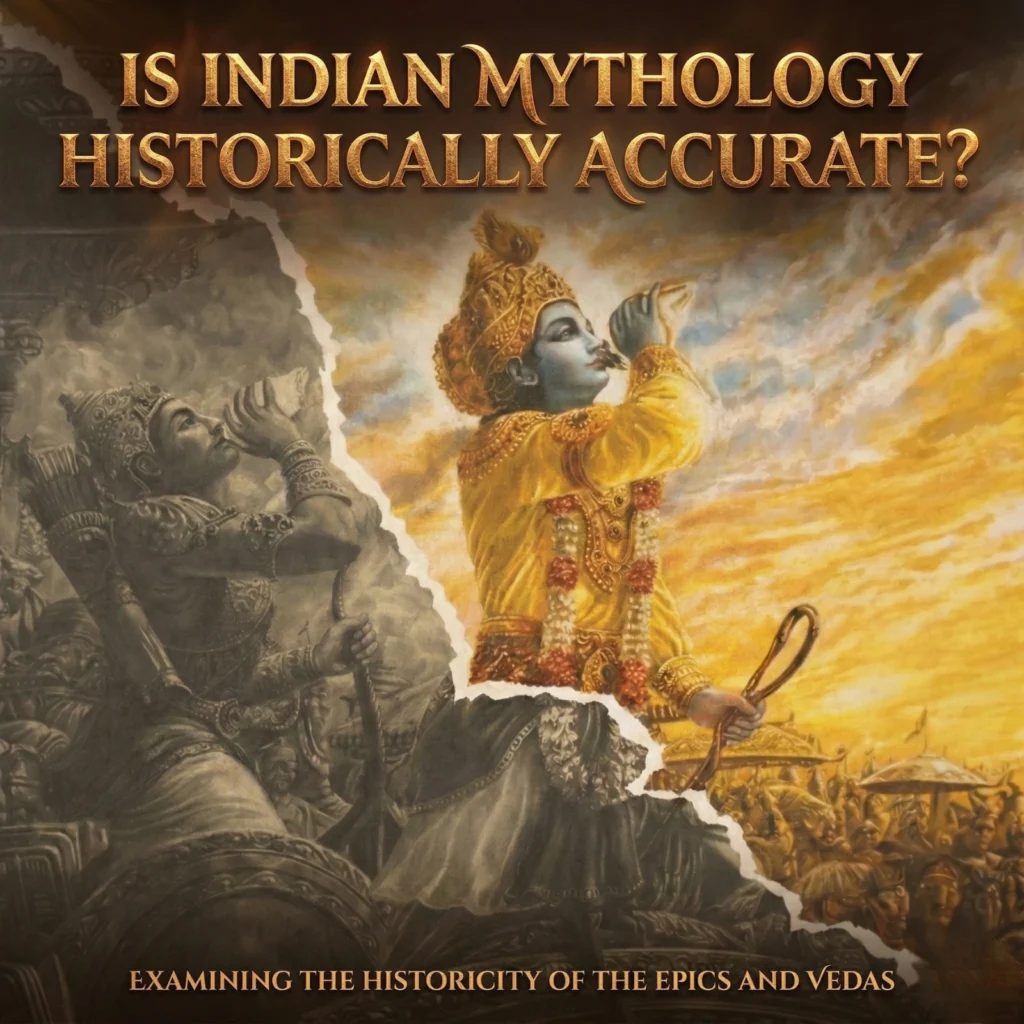
“Is the Ramayana real?”
“Did the Mahabharata actually happen?”
“Are Hindu gods historical figures or fictional characters?”
These are among the most searched questions about Indian sacred narratives. And they’re also the wrong questions or at least, questions that reveal how deeply colonial frameworks still shape how we think.
Because the question “is it real?” assumes a binary: either something is empirically verifiable historical fact, or it’s false fiction. But as I’ve explored throughout my work, sacred narratives operate in categories that don’t map neatly onto the Western “history vs myth” divide.
The Sanskrit term for the Ramayana and Mahabharata is Itihasa (इतिहास) literally “thus it was” or “it happened thus.” Not “history” in the modern empirical sense. Not “myth” meaning false story. A third category: sacred narrative understood as preserving real events, elaborated with philosophical depth, symbolic meaning, and devotional significance.
So when someone asks “is Indian mythology real?”, they’re smuggling in assumptions. The question itself is colonized.
Let me unpack this carefully, examining:
- What evidence exists (archaeological, astronomical, textual)
- Why “real or fake” is the wrong frame
- What Itihasa actually means
- How colonial scholarship created the “mythology vs history” problem
- What’s at stake in this debate
This won’t be a simple “yes it’s all true” or “no it’s all fake.” Reality is more interesting than that.
The Archaeological Evidence: What We’ve Found
Let’s start with what can be empirically verified:
Dwarka: Krishna’s Sunken City
In the 1980s, marine archaeologist S.R. Rao led underwater expeditions off the coast of Gujarat. What they found: an ancient submerged city precisely where texts locate Krishna’s capital Dwarka.
Discoveries:
- Stone anchors
- Fort walls
- Building foundations
- Harbor structures
- Pottery and artifacts
Dating: Carbon dating places artifacts at ~3,500 years old (roughly 1500 BCE).
Significance: The Mahabharata describes Dwarka submerging into the ocean after Krishna’s departure. Here’s a city, underwater, where the text said it would be, from approximately the right period.
Does this prove Krishna literally lived? No. But it proves ancient coastal settlements existed where texts describe them, suggesting these texts preserve geographical memory, not pure invention.
Kurukshetra: The Mahabharata War Site
Excavations at Kurukshetra in Haryana have uncovered:
- Painted Grey Ware (PGW) pottery associated with Late Vedic period
- Evidence of large-scale habitation around 1000 BCE
- Artifacts consistent with the Iron Age
Historian B.B. Lal correlated PGW sites with places mentioned in the Mahabharata. Many match.
What this tells us: Real kingdoms existed in the regions described. The political geography in the Mahabharata reflects actual Late Vedic period reality.
Ram Setu (Adam’s Bridge)
Between India (Dhanushkodi) and Sri Lanka (Talaimannar) lies a chain of limestone shoals forming a natural bridge across Palk Strait.
The claim: This is the bridge Rama’s vanara army built to reach Lanka.
Scientific reality: Geological surveys show it’s a natural formation coral reefs and sand banks. NASA satellite imagery shows the structure clearly.
Age: Geological estimates range from 7,000 to 18,000 years old (varying by formation layer).
The debate: Natural formation or ancient construction? Geologists say natural. Devotees point to unusual straightness and stone placement. Carbon dating of materials on the bridge shows organic elements from different eras.
Bottom line: A physical structure exists where texts describe it. Whether humans modified natural formations remains contested.
Ayodhya: Rama’s Capital
Archaeological excavations by ASI (Archaeological Survey of India) at Ayodhya have found:
- Continuous habitation from ~8th century BCE
- Artifacts indicating ancient urban settlement
- Temple structures (though dates are politically contested)
What’s established: Ayodhya was a significant ancient city. Whether it was specifically Rama’s capital is unprovable archaeologically, but it wasn’t invented by poets.
The Astronomical Evidence: Dating Through Star Positions
Ancient Indian texts describe astronomical positions with precision. Modern software can calculate when those configurations actually occurred.
Dating the Mahabharata War
The Mahabharata provides specific astronomical data:
- Positions of planets
- Lunar mansions (nakshatras)
- Eclipse descriptions
- Constellation placements
Multiple researchers have calculated dates based on these descriptions:
- Aryabhata (6th century): 3102 BCE (based on planetary conjunctions)
- Modern calculations: Range from 3100 BCE to 1000 BCE depending on which passages are used
The variability matters: Different verses yield different dates, suggesting either: a) Multiple authors from different periods, or b) Compositional layers added over centuries
Dating the Ramayana
Astronomical references in Valmiki’s Ramayana have been analyzed by various researchers.
Claimed dates range from:
- 7000 BCE (most extreme claims)
- 5000 BCE (based on certain planetary alignments)
- 1500 BCE (more conservative estimates)
The problem: Astronomical dating depends heavily on:
- Which verses you use (some may be later additions)
- How you interpret poetic language
- Whether descriptions are allegorical or literal
The Textual Evidence: What the Texts Themselves Say
Itihasa vs Purana: Indigenous Categories
Indian tradition distinguishes between:
Itihasa (इतिहास):
- Ramayana and Mahabharata
- Means “thus it happened”
- Understood as narratives of past events
- Composed by witnesses (Valmiki for Ramayana, Vyasa for Mahabharata)
Purana (पुराण):
- Texts about gods, cosmology, creation
- Means “ancient knowledge”
- Not claimed as eyewitness accounts
- Theological rather than historical focus
This indigenous distinction matters. Ancient Indians categorized these texts differently than modern categories allow.
Sangam Literature References
Tamil Sangam literature (200 BCE – 200 CE) references Rama and the bridge to Lanka multiple times, suggesting these narratives were widespread and taken seriously centuries before the common era.
Mahabharata’s Self-Understanding
The Mahabharata explicitly calls itself “itihasa” not Purana, not kavya (poetry), but itihasa.
“This itihasa called the Bharata is equal to the Vedas, was composed by the sage Vyasa… He who listens to this great and celestial story… shall rise to svarga (heaven).”
The text claims to be witnessed history, not invented fiction.
Why “Real or Fake?” Is the Wrong Question
Here’s where we need to step back and question the question itself.
The Colonial Creation of “Mythology”
As I discussed extensively, the term “Hindu mythology” was imposed by British colonial scholars in the 18th-19th centuries.
Their project:
- Create a category (“mythology”) for Indian sacred texts
- Position them as primitive, pre-scientific storytelling
- Contrast them with “history” (Western, scientific, rational)
- Establish European epistemic superiority
Calling the Ramayana “mythology” wasn’t neutral classification. It was intellectual colonization defining Indian knowledge systems through Western categories, then finding them deficient by Western standards.
Modern History’s Narrow Definition
“History” as practiced today emerged in 19th century Europe with very specific requirements:
- Documentary evidence
- Archaeological verification
- Critical skepticism of sources
- Separation from religious or mythic elements
This is one way of understanding the past. Not the only way. Not even the oldest way.
Ancient cultures Indian, Greek, Egyptian, Native American had other frameworks for preserving and transmitting knowledge about the past.
Dismissing all pre-modern historical knowledge as “myth” because it doesn’t meet modern historiographic standards is presentist arrogance.
What Itihasa Actually Means
Itihasa occupies a third space between modern “history” and “myth”:
Like history:
- Claims to describe real events
- Names real places and kingdoms
- Preserves cultural memory
- Used as historical source by ancient kings tracing lineage
Like mythology (in the good sense):
- Uses poetic language
- Includes philosophical discourse
- Contains supernatural elements
- Serves spiritual and ethical purposes
Unlike either:
- Not bound by empirical verification (history’s requirement)
- Not admitting to being fiction (mythology in the “false” sense)
- Operating in a framework where historical fact and spiritual truth aren’t separate categories
When you ask “is Itihasa real?”, you’re forcing it into a category it refuses.
The Evidence That Makes Believers Confident
Many Hindus believe the epics describe real events. Here’s why:
1. Unbroken Tradition
Rama worship has continued unbroken for thousands of years. Kings traced lineage to him. Festivals celebrate his return to Ayodhya. Temples mark his journey.
If he never existed, how did this tradition survive conquest, foreign rule, and skepticism?
2. Geographical Consistency
The Ramayana describes a journey from Ayodhya through central India to Sri Lanka. Every major location mentioned Chitrakoot, Dandakaranya, Kishkinda, Rameshwaram still exists and has associated traditions.
Pure invention wouldn’t be so geographically precise.
3. Cultural Continuity
Southeast Asian countries Thailand, Indonesia, Cambodia, Laos have Ramayana traditions predating Western influence. How did they get these narratives if they’re recently invented myths?
4. Comparative Evidence
The Bible describes the Great Flood, miraculous events, and fantastical occurrences. Yet it’s treated as historical (at least regarding kingdoms, kings, and political events) by Western academia.
Why the double standard? Why is the Bible “history with miraculous elements” while the Ramayana is “mythology”?
The Evidence That Makes Skeptics Doubtful
Academic historians remain skeptical for legitimate reasons:
1. Lack of Contemporary Records
No inscriptions or artifacts from the purported time of Rama or Krishna explicitly mention them.
The earliest references are in texts composed centuries later.
2. Supernatural Elements
Gods taking avatar. Monkeys building bridges. Demons with ten heads. Flying vehicles (vimanas).
These elements make empiricist historians skeptical that the texts describe literal events.
3. Multiple Versions
The Ramayana has hundreds of versions Valmiki’s, Tulsidas’s, Thai, Indonesian, Buddhist versions all differing in details.
If describing a single historical event, why so much variation?
4. Anachronisms
Texts contain elements from different periods Late Vedic kingdoms alongside later philosophical concepts suggesting composition over centuries, not eyewitness accounts.
What Serious Scholars Actually Say
The academic middle ground is more nuanced than either “all real” or “all fake”:
Archaeological Consensus
“The Mahabharata describes a war at Kurukshetra. Archaeological evidence shows Late Vedic settlements exactly where described. A core historical event likely occurred, later elaborated and mythologized.”
Textual Consensus
“Core narratives seem to relate to events from a period prior to all but the Rig Veda.”
Astronomical Consensus
Multiple dates are possible depending on interpretation. This suggests:
- Astronomical descriptions might be symbolic, not literal
- Texts were composed/edited over long periods
- Some passages are more historically grounded than others
The Middle Path
Most serious scholars conclude:
“The epics likely preserve memories of real kingdoms, conflicts, and figures, heavily elaborated with religious, philosophical, and artistic elements. They’re not pure invention, but they’re also not historical chronicles in the modern sense.”
What’s Actually at Stake in This Debate
The “real or fake” question isn’t just academic. It carries political and cultural weight:
For Hindu Nationalists
Proving the epics are “history” becomes:
- Validation of Hindu civilization’s antiquity
- Defense against colonial dismissal
- Political tool for asserting Hindu majority claims
This can lead to:
- Dismissing academic skepticism as anti-Hindu
- Ignoring evidence that complicates neat narratives
- Weaponizing “historicity” for contemporary politics
For Secular Academics
Maintaining critical distance becomes:
- Defense of scientific method
- Resistance to religious nationalism
- Preservation of historical integrity
This can lead to:
- Dismissing legitimate evidence for continuity
- Underestimating cultural memory preservation
- Imposing Western categories without acknowledging bias
For Devotees
The question “did Rama exist?” can feel:
- Insulting (implying faith is based on lies)
- Irrelevant (spiritual truth matters more than historical fact)
- Colonial (who gets to define what’s “real”?)
The Honest Answer
So: Is Indian mythology real?
The honest answer has multiple parts:
1. Real kingdoms, places, and likely some historical cores exist.
The geographical precision, archaeological finds, and cultural continuity suggest these narratives preserve memories of real places and possibly real conflicts.
2. Supernatural elements aren’t literally true by modern empirical standards.
Gods taking avatar, demons, flying vehicles these don’t match observable reality as modern science defines it.
3. The category “mythology” is itself problematic.
It’s a colonial imposition that forces Indian texts into Western frameworks. Itihasa is a different category deserving engagement on its own terms.
4. Historical truth and spiritual truth aren’t the same category.
You can extract profound ethical, philosophical, and spiritual insights from the Ramayana whether or not Rama literally existed as described.
5. The question “is it real?” reveals what you value.
If you value empirical verification above all else, you’ll be skeptical. If you value cultural tradition and continuity, you’ll be more convinced. If you value spiritual truth, you might find the question irrelevant.
A Better Question
Instead of “Is Indian mythology real?”, ask:
“What kind of truth do these narratives preserve?”
They preserve:
- Geographical knowledge (real places)
- Cultural memory (kingdoms, conflicts)
- Ethical wisdom (how to live righteously)
- Philosophical insights (nature of reality, duty, devotion)
- Spiritual frameworks (relationship between human and divine)
- Social ideals (kingship, brotherhood, devotion)
Are those “real”? Absolutely.
Are they “history” in the modern sense? Not exactly.
Are they “myth” meaning false? Absolutely not.
They’re Itihasa “thus it happened” a category that includes factual memory, philosophical depth, and spiritual significance in ways that resist being reduced to either “history” or “myth.”
Conclusion: Beyond the Binary
The “is it real?” question comes from a colonized mind that accepts only Western epistemological categories as legitimate.
The Ramayana and Mahabharata are:
- Not modern history (they don’t meet historiographic standards)
- Not pure fiction (they preserve too much geographical and cultural accuracy)
- Not “mythology” in the dismissive sense (they’re taken seriously by living tradition)
- Itihasa a category that deserves to be understood on its own terms
Archaeological evidence will continue emerging. Some will support historicity of core events. Some will complicate narratives. Both outcomes are fine.
Because the real question isn’t “Did Rama exist?”
The real question is: “What do we learn from the narratives about Rama that have shaped civilization for thousands of years?”
And that answer about dharma, duty, sacrifice, love, devotion, the cost of righteousness is undeniably real.
Whether Rama walked the earth or not, the truths his story teaches walk the earth every day, in the lives of billions who try to live with integrity.
And that kind of reality? That matters more than empirical verification.
Frequently Asked Questions
Indian mythology cannot be simply labeled real or fake and forcing it into that binary misses the point entirely. It exists at the intersection of cultural memory, philosophical inquiry, and sacred storytelling. Some narratives preserve echoes of real places, events, and historical structures. Others operate entirely in the realm of symbol and meaning. The more useful question is not “did this literally happen?” but “what truths does this story convey?” Mythology is the narrative framework through which a civilization makes meaning of existence, morality, and the cosmos. Judging it by the standards of modern empirical history is like judging a poem by whether it follows the rules of journalism. Both are legitimate forms of human expression. Neither is the other.
Itihasa (इतिहास) literally means “thus it happened” a Sanskrit category that sits between myth and history, describing narratives understood as preserving real events but composed with philosophical and spiritual depth. The Ramayana and Mahabharata are classified as Itihasa, not Purana (cosmic tales), and not modern “history.” The label “mythology” was largely imposed by colonial British scholars in the 18th and 19th centuries who classified Indian sacred texts as primitive pre-scientific storytelling a framing that served to establish Western epistemological authority over Indian knowledge systems. Many Indian scholars today prefer “sacred narrative” or simply use the indigenous term Itihasa, which refuses the real-or-false binary and holds both historical and spiritual truth simultaneously.
No definitive archaeological proof exists for either figure no contemporary inscriptions or artifacts from their purported eras explicitly name them. However, circumstantial evidence is not absent. Ayodhya shows ancient continuous habitation. Tamil Sangam literature (200 BCE–200 CE) references Rama, confirming pre-Common Era widespread tradition. For Krishna, the strongest physical evidence is the underwater city of Dwarka discovered off Gujarat’s coast in the 1980s a submerged ancient city exactly where the Mahabharata places Krishna’s capital, carbon-dated to approximately 1500 BCE. This proves an ancient coastal city existed where described, though not that Krishna personally lived there. For a billion Hindus, existence is established by living tradition, not archaeology much as no physical evidence names Jesus Christ, yet Christianity builds its entire foundation on his life.
There is suggestive but not conclusive evidence. Ram Setu (Adam’s Bridge) exists as a real natural formation between India and Sri Lanka exactly where the text describes it, though geologists say it formed naturally over thousands of years. Botanical studies have confirmed that 182 plants mentioned in the Ramayana exist in the described regions. Astronomical calculations based on planetary configurations in the text yield dates ranging from 7000 BCE to 1500 BCE depending on interpretation. No contemporary inscriptions explicitly mention Rama. The scholarly consensus is that the text preserves genuine geographical and cultural memory of ancient India while embedding it within religious and philosophical storytelling making it simultaneously historical in its setting and sacred in its purpose.
Many historians believe a real historical conflict underlies the Mahabharata, mythologized over centuries. Archaeological evidence shows Late Vedic kingdoms existed at sites the text names Hastinapur, Indraprastha (modern Delhi), Kurukshetra. Painted Grey Ware pottery found at these locations matches the epic’s timeline. The underwater city of Dwarka also corroborates key geographical claims. Most scholars date a possible historical war to around 1000–900 BCE based on archaeology, while astronomical references in the text itself suggest 3102 BCE. The working consensus: a real dynastic conflict likely occurred, which then accumulated centuries of retelling adding divine figures, supernatural weapons, and the Bhagavad Gita’s philosophical teachings until the event and the epic became inseparable.
Traditional dating based on astronomical references within the texts and Puranic genealogies places the Mahabharata war at 3102 BCE and the Ramayana even earlier. Modern historians date the composition of the Ramayana to around 500 BCE and the Mahabharata between 400 BCE and 400 CE, based on linguistic analysis, anachronisms indicating multiple authorship layers, and the absence of contemporary written records. The key distinction is that traditional dating calculates when described events occurred; modern dating calculates when the texts were written down. Both can be partially correct events may have occurred earlier, while the texts as we have them were composed and expanded over later centuries, preserving older memory in newer literary form.
Yes and this distinction is essential for understanding sacred narratives. The Ramayana’s teachings on dharma, sacrifice, and righteousness carry their full weight whether or not Rama literally existed as described. The Bhagavad Gita’s philosophy of detached action remains one of the most practically powerful ideas ever articulated, regardless of whether the Kurukshetra war happened exactly as told. Many religious and philosophical traditions make this distinction explicitly. What matters is not whether the story is factually verifiable, but whether it is transformative whether it teaches ethical conduct, provides meaning, and connects human beings to something larger than themselves. If it does, it is true in the ways that matter most.
History aims to document verifiable events through evidence inscriptions, archaeology, contemporary records. Mythology communicates meaning through story, symbol, and narrative it interprets rather than documents. In India, the two are often deeply intertwined rather than clearly separated. The Ramayana and Mahabharata preserve real geographies, cultural practices, and possible historical memories, while simultaneously operating as philosophical and spiritual texts. This overlap is not confusion it reflects a different epistemological tradition, one in which factual memory and sacred meaning are not considered separate categories that must be kept apart, but complementary layers of a single truth.
No. The value of mythology lies in the truths it conveys, not in its historical verification. Myths address the questions that matter most to human beings how to live, what constitutes right action, what we owe each other, what the universe is and where we stand within it. These questions do not become more answerable by proving that a particular battle happened in 3000 BCE. What makes the Ramayana enduring is not the possibility that Rama was a real king it is that his choices, his sacrifices, and his moral clarity have given millions of people a language for their own struggles across thousands of years. That kind of truth is real. It just operates differently than archaeology.
Indian mythology teaches dharma (right conduct and duty), karma (action and consequence), the nature of the self, and the relationship between the individual and the cosmos. These are not abstract concepts they are practical guides for navigating real moral dilemmas, relationships, leadership, and personal growth. The epics remain relevant today because the human situations they describe have not changed: the conflict between duty and desire, the cost of integrity, the nature of devotion, the question of what makes a life meaningful. Every generation finds itself in the Ramayana and Mahabharata because every generation faces the same fundamental choices. That is not coincidence. That is what great mythology does it maps the permanent terrain of human experience in stories vivid enough to last forever.
Continue Your Journey

About the Author
Priyanka Sharma Kaintura
Priyanka Sharma Kaintura is a mythology writer, author, and speaker
dedicated to challenging colonial frameworks while engaging respectfully
with sacred traditions. After two decades in corporate communication,
she now writes full-time, exploring how ancient narratives address
questions of truth, meaning, and knowledge that transcend simple
“real or fake” binaries.
Her books include
Mahadevi: The Unseen Truth Behind Existence
and
My Jiffies: Narration of Moments, Unadulterated and Unpackaged
.


