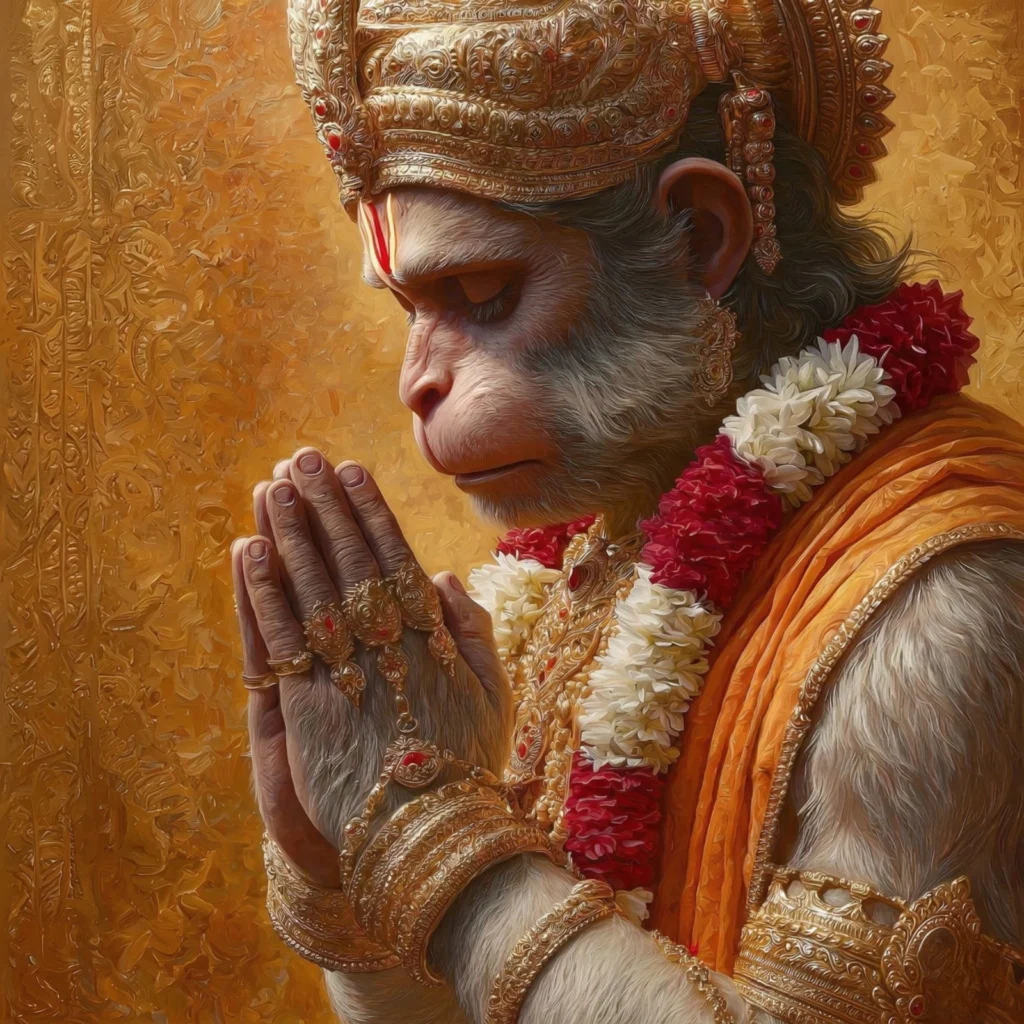
Walk into almost any Indian home, shop, or gym, and you’ll likely see an image of Hanuman the monkey-faced god with his chest ripped open to reveal Rama and Sita residing in his heart.
Wrestlers worship him. Scholars invoke him. Children hear stories about him. Devotees chant his name: “Jai Hanuman!” (Victory to Hanuman!)
But who is this figure? And why has he become one of the most beloved deities in Hinduism not just in India, but globally?
The answer lies in a unique combination: Hanuman is the only major Hindu deity who is himself a devotee rather than an object of devotion.
While Shiva, Vishnu, and the Goddess are worshipped as ultimate reality, Hanuman worships Rama. He’s not God demanding service he’s the perfect servant showing how service should look.
And paradoxically, this is why people worship him. Because his devotion (bhakti) is so complete, his strength (shakti) so immense, his humility so profound, that he becomes the model for how to relate to the divine.
As I’ve explored throughout my work on mythology, sacred narratives function on multiple levels. Hanuman operates as: superhero (miraculous feats), theological ideal (perfect devotion), psychological archetype (ego transcendence), and living presence (temples worldwide).
Let me introduce you to this extraordinary figure not as ancient mythology, but as living theology still transforming lives.
Who Is Hanuman? The Basics
Hanuman (हनुमान्) is a deity in Hinduism, revered as:
- Divine vanara (monkey being)
- Son of Vayu (wind god) and Anjana (celestial nymph)
- Most devoted companion of Lord Rama
- Chiranjivi (immortal one) still alive, serving Rama eternally
- Embodiment of shakti (strength) and bhakti (devotion)
Etymology and Names
“Hanuman” comes from hanu (jaw) + man (having), referring to an incident where Indra struck him on the jaw with a thunderbolt.
He’s also called:
- Bajrangbali (one with limbs strong as thunder)
- Pawanputra (son of wind)
- Anjaneya (son of Anjana)
- Maruti (son of Marut, the wind god)
- Ramdoot (messenger of Rama)
- Sankat Mochan (remover of difficulties)
Each name emphasizes different qualities strength, lineage, or devotional service.
Hanuman in Sacred Texts
Hanuman appears prominently in:
- Ramayana (Valmiki’s version, ~3rd century BCE) where he’s Rama’s greatest ally
- Ramcharitmanas (Tulsidas, 16th century) where he’s elevated to central theological importance
- Mahabharata where he appears as Bhima’s brother and teacher
- Hanuman Chalisa 40-verse devotional hymn by Tulsidas, one of Hinduism’s most recited prayers
His theological significance emerged primarily in the medieval period, especially through the Bhakti movement, which positioned him as the ideal loving devotee.
The Birth and Childhood: Divine Mischief
Hanuman’s birth itself is miraculous.
The Curse and the Boon
Anjana was an apsara (celestial nymph) cursed by a sage to be born as a monkey. The curse could only be broken if she gave birth to a divine son.
She performed intense tapasya (spiritual austerity) to please Shiva. Moved by her devotion, Shiva blessed her: “You will bear a son who embodies my power.”
Meanwhile, King Dasharatha (Rama’s father) was performing a yajna (fire ritual) for sons. The ritual’s divine payasam (sacred pudding) was carried by the wind god Vayu to Anjana, who consumed it.
Thus Hanuman was born son of Vayu (biologically) and blessed with Shiva’s power (spiritually).
The Sun-Swallowing Incident
As a child, Hanuman saw the rising sun and thought it was a ripe fruit. Using his ability to fly, he leaped into the sky to grab it.
Indra, alarmed that the cosmic order was being disturbed, struck Hanuman with his vajra (thunderbolt). The blow hit Hanuman’s jaw, and he fell to earth dead.
Vayu, enraged that his son had been killed, withdrew all air from the universe. Living beings began suffocating. The gods panicked.
Brahma revived Hanuman, and the gods granted him boons:
- Immortality (chiranjivi status)
- Body as strong as Indra’s vajra
- Immunity to all weapons
- Ability to change size at will
- Supreme strength
The Curse of Forgetfulness
Young Hanuman was mischievous, using his powers to disturb sages in meditation.
Frustrated, the sages cursed him: “You will forget your powers until someone reminds you of them.”
This curse becomes crucial to the Ramayana narrative Hanuman doesn’t know his own strength until reminded.
Symbolism: We all forget our divine potential. We need teachers, crises, or devotion to remind us of the power within.
The Ramayana: Hanuman’s Finest Hour
Hanuman’s greatest role is in the Ramayana, helping Rama rescue Sita from Ravana.
Meeting Rama
When Rama and Lakshmana (in exile) search for the kidnapped Sita, they meet Sugriva, exiled king of the vanara (monkey) kingdom.
Hanuman, Sugriva’s minister, is sent to assess these mysterious warriors. The moment Hanuman sees Rama, he recognizes divinity.
He offers service. Rama accepts. And in that moment, Hanuman’s life purpose crystallizes: serve Rama, forever.
This isn’t coerced. It’s spontaneous, joyful recognition: “This is my Lord. This is why I exist.”
The Leap to Lanka
Sita is imprisoned on Lanka, Ravana’s island kingdom. The ocean separates India from Lanka.
The vanara army stands at the shore, despairing. “How will we cross?”
Jambavan, the wise bear, reminds Hanuman: “You have forgotten your power. You are Vayu’s son. You can fly. You can change size. You are capable of anything.”
Awakened to his true nature, Hanuman grows to enormous size and leaps clearing the ocean in a single bound.
Theological meaning: When reminded of our divine nature (by guru, by scripture, by grace), we discover we’re capable of the impossible.
Finding Sita
In Lanka, Hanuman searches the demon kingdom. He finds Sita in Ashoka grove, guarded by rakshasa women, resisting Ravana’s threats.
Hanuman appears in miniature form, presents Rama’s ring as proof of his mission, and offers to carry her back.
Sita refuses: “Rama himself must rescue me. A wife must be saved by her husband.” (Some versions emphasize her agency; others emphasize dharmic propriety.)
Hanuman accepts. He destroys part of the Ashoka grove to send a message: “Rama’s messenger was here.”
Setting Lanka Ablaze
Ravana’s son Akshayakumara captures Hanuman and brings him before Ravana.
The demon king, respecting diplomatic immunity, refuses to kill a messenger but orders Hanuman’s tail set on fire as punishment.
Hanuman uses his size-changing power to grow his tail endlessly. The demons run out of cloth to wrap it. While they apply oil and light the fire, Hanuman shrinks, breaks free, and uses his burning tail to set all of Lanka ablaze.
He flies back across the ocean, tail extinguished, mission accomplished.
Symbolism: What enemies intend as humiliation, devotees transform into victory. Fire meant to harm becomes the weapon of justice.
The War: Sanjeevani Mountain
During the climactic battle, Rama’s brother Lakshmana is mortally wounded. Only the Sanjeevani herb, found on a distant Himalayan mountain, can save him and it must be delivered before dawn.
Hanuman flies to the Himalayas. But he can’t identify which herb is Sanjeevani there are too many plants.
His solution? Lift the entire mountain and fly it back.
Lakshmana is saved. The war continues. Good triumphs.
Meaning: When in doubt, give everything. When you don’t know which small action is needed, offer the mountain.
Hanuman’s Unique Position: The Devotee-Deity
What makes Hanuman theologically unique is that he occupies two positions simultaneously:
He Is a Deity
Hanuman has his own temples, festivals (Hanuman Jayanti), prayers (Hanuman Chalisa), and millions of devotees.
People worship him for:
- Strength in facing challenges
- Protection from harm
- Removal of obstacles (like Ganesha)
- Spiritual progress and devotion
- Physical health and courage
He Is a Devotee
Yet Hanuman himself worships Rama. His entire existence is service.
He never seeks glory. When praised, he deflects: “All I did was by Rama’s grace.”
When offered boons, he asks only: “Let me serve Rama forever.”
His chest bears the image of Rama and Sita literally in his heart.
This dual nature makes him accessible. He’s divine enough to grant blessings, but humble enough that ordinary people identify with his devotion.
The Theology of Hanuman: Shakti Meets Bhakti
Hanuman embodies the perfect integration of:
Shakti (शक्ति) power, strength, energy Bhakti (भक्ति) devotion, love, surrender
Most traditions emphasize one or the other. Warriors cultivate shakti but may lack devotion. Devotees cultivate bhakti but may lack courage.
Hanuman has both maximally:
- Incomparable strength (can lift mountains, leap oceans, fight armies)
- Complete devotion (every action for Rama, zero ego, total surrender)
This combination is revolutionary. It says: Real power comes through devotion. Real devotion generates power.
You don’t sacrifice one for the other. They’re one reality.
Hanuman Chalisa: The Most Recited Prayer
The Hanuman Chalisa (हनुमान चालीसा) is a 40-verse devotional hymn composed by Tulsidas in the 16th century.
It’s one of the most widely recited texts in Hinduism millions chant it daily.
Why Is It So Popular?
1. Accessibility: Simple language (Awadhi Hindi), easy to memorize
2. Power: Believed to grant protection, remove obstacles, dispel fear
3. Comprehensive: Describes Hanuman’s qualities, deeds, and theology
4. Devotional: Creates intimate relationship with Hanuman
Key Verses
Opening invocation:
“Knowing this body to be devoid of intelligence, I remember the Son of Wind / Grant me strength, intelligence, and knowledge, and remove all my afflictions and shortcomings.”
Central declaration:
“In every age (yuga), wherever Rama’s story is sung / There, O Hanuman, you remain present, with tears of devotion flowing.”
This verse claims: Hanuman is still alive, attending every recitation of Rama’s name.
Hanuman Today: Living Worship
Hanuman worship has exploded in modern times:
Hanuman Jayanti
His birthday (celebrated in March-April, depending on the lunar calendar) is marked by:
- Temple visits and special pujas
- Recitation of Hanuman Chalisa
- Processions with Hanuman’s image
- Distribution of prasad (sacred food)
Tuesday and Saturday Devotions
Many devotees observe:
- Tuesdays: Considered Hanuman’s day
- Saturdays: Also associated with him in North India
They visit Hanuman temples, chant the Chalisa, offer sindoor (vermillion), and seek blessings.
Wrestlers and Athletes
Hanuman is the patron deity of wrestlers, martial artists, and athletes.
Traditional Indian wrestling schools (akhara) worship Hanuman before training. Modern gyms display his image.
Why? His combination of physical strength, discipline (celibacy), and mental focus embodies athletic ideals.
Global Spread
Hanuman worship has spread through:
- ISKCON and other Vaishnava movements
- Yoga studios (even secular ones display Hanuman)
- Southeast Asia: Thailand (where he’s called Hanuman too), Indonesia, Cambodia all have Hanuman traditions
- Diaspora communities: Hanuman temples in North America, Europe, Africa, Caribbean
What Hanuman Teaches Us
Even if you don’t practice Hinduism, Hanuman offers profound lessons:
Strength Through Service
Hanuman is immensely powerful but never for personal gain. All strength is deployed in service.
Modern culture often frames power as dominance. Hanuman reframes it as capacity to serve.
Real strength protects the vulnerable, upholds dharma, serves a higher purpose.
Devotion Awakens Potential
Hanuman’s powers were dormant until devotion to Rama awakened them.
The lesson: You don’t fully know your capabilities until you find something worth serving completely.
Purpose unlocks power. Love reveals strength you didn’t know you had.
Humility Amidst Greatness
Despite miraculous achievements, Hanuman takes no credit. “It was all Rama’s grace.”
He could boast. He could demand worship as equal to Rama. Instead, he remains the eternal servant.
This is radical spiritual teaching: Greatness without ego is possible.
Persistence Over Perfection
Hanuman doesn’t always know the perfect solution (which herb? lift the whole mountain!). But he never quits.
He adapts, improvises, persists. The mission matters more than looking good.
Living in Service Is Joyful
Many spiritual paths emphasize renunciation, detachment, transcending desire.
Hanuman offers an alternative: Find what you love (Rama), serve it totally, and that becomes liberation.
Service doesn’t have to be joyless duty. Bhakti is bliss.
Hanuman and Contemporary Movements
Hanuman’s symbolism has been adopted by various movements:
Bhakti Yoga in the West
Teachers like Ram Dass, Krishna Das, and Jai Uttal all devotees of Neem Karoli Baba (considered Hanuman’s incarnation) brought Hanuman to Western yoga.
Through kirtan (devotional chanting) and bhakti yoga (yoga of devotion), Hanuman entered mainstream American spirituality.
Nationalist Appropriation
Unfortunately, Hanuman has also been weaponized by Hindu nationalist movements as a symbol of strength and “resistance.”
This misuses him. The real Hanuman serves dharma, not ethnic nationalism. His strength protects all beings, not one community against others.
As I’ve discussed throughout my work on how mythology functions, sacred symbols can be distorted. Critical engagement means reclaiming authentic meanings.
Conclusion: The Eternal Servant
Hanuman embodies a paradox: the servant who becomes God.
He never seeks divinity. He seeks only to serve Rama. But that complete devotion shakti united with bhakti makes him divine.
And he’s still serving. According to tradition, Hanuman is chiranjivi immortal. Wherever Rama’s name is sung, Hanuman is present, listening with tears of joy.
You might dismiss this as mythology. But for millions, it’s lived reality. They feel Hanuman’s presence. They experience his protection. They find strength in his example.
Because whether Hanuman is “literally” alive matters less than the truth he represents:
Perfect devotion is possible. Strength in service is real. Ego can be transcended. Power can be humble. And when you find what’s worth serving completely, you discover who you really are.
As the Ramayana teaches, Hanuman didn’t just help Rama rescue Sita. He showed that the highest human potential is divine devotion expressed through selfless strength.
And that teaching endures in temples, in gyms, in hearts wherever someone chants:
Jai Hanuman!
Frequently Asked Questions
Hanuman is a central figure in Hindu tradition, revered as a divine being of immense strength and unwavering devotion. He is born to Anjana and blessed by Vayu, the wind god, which explains both his vitality and his speed. Unlike many deities associated with sovereignty or cosmic authority, Hanuman’s identity is grounded in service. His life illustrates the integration of physical power with spiritual discipline. He is not defined by status but by purpose. Through him, the tradition presents a model of devotion that is active, disciplined, and deeply aligned with dharma.
Hanuman is described as possessing extraordinary abilities that extend beyond physical strength. He can alter his size at will, traverse vast distances through flight, and withstand weapons that would destroy ordinary beings. In addition to his physical capabilities, he is portrayed as highly learned, with mastery over language and scripture. His intellect complements his strength, making him a balanced and formidable figure. These powers are not exercised for personal gain but are consistently directed toward service. This alignment of ability and purpose is central to his character.
In the Ramayana, Hanuman serves as a crucial agent in the rescue of Sita and the success of Rama’s mission. He is the one who discovers Sita in Lanka, establishing a vital link between her and Rama. His journey across the ocean demonstrates both courage and clarity of purpose. He delivers messages, gathers intelligence, and performs acts that shift the course of the narrative. His contribution is not incidental but essential to the outcome. Through his actions, the epic highlights the power of devoted service in achieving seemingly impossible goals.
Hanuman is considered the ideal devotee because his actions are entirely free of personal ambition. His devotion to Rama is expressed through consistent, selfless service rather than ritual alone. He does not seek recognition or reward, and his sense of identity is rooted in loyalty. This level of surrender reflects the highest form of bhakti described in Hindu philosophy. His devotion is not passive but expressed through decisive action. As a result, he becomes both a spiritual exemplar and a source of inspiration for practitioners.
Hanuman is traditionally counted among the chiranjivis, beings believed to exist beyond normal human lifespans. This status signifies continuity rather than mere longevity, placing him outside ordinary temporal limits. His presence is often associated with places where Rama’s name is remembered or recited. The idea of his immortality functions both as belief and as symbolic expression. It suggests that the qualities he embodies remain accessible across time. In this sense, his continued existence is as much philosophical as it is mythological.
The Hanuman Chalisa is a widely recited devotional text composed in the Awadhi language. It consists of forty verses that praise Hanuman’s qualities and recount key aspects of his role in the Ramayana. Its accessibility has contributed to its widespread adoption across different communities. Recitation is often associated with cultivating mental clarity and emotional strength. The text functions as both prayer and reflection. Its enduring popularity reflects the continuing relevance of Hanuman’s character and the values he represents.
Hanuman’s monkey form originates from his birth as a vanara, a class of beings with both human and animal characteristics. This form carries symbolic significance rather than serving as a limitation. It represents agility, alertness, and a dynamic form of intelligence. Within the narrative framework, vanaras are portrayed as capable and organized, not primitive. Hanuman’s appearance challenges conventional associations between form and worth. It emphasizes that spiritual stature is independent of outward appearance.
Hanuman’s life presents a clear distinction between strength as force and strength as discipline. He possesses immense power yet exercises it with restraint and purpose. His humility does not diminish his capabilities but ensures they are used appropriately. This combination allows him to act effectively without being driven by ego. His example demonstrates that true strength is inseparable from self-control. It is this balance that defines his enduring significance.
Hanuman and Ganesha are both associated with overcoming obstacles, yet they represent different approaches. Ganesha is linked with wisdom and is traditionally invoked at the beginning of endeavors. Hanuman, by contrast, is associated with perseverance and strength during challenges. Their roles complement rather than compete with each other. One prepares the path, while the other sustains movement through difficulty. Together, they illustrate different dimensions of problem-solving within the tradition.
Hanuman remains significant because the qualities he represents continue to resonate in modern contexts. Strength, discipline, and resilience are as relevant today as in ancient narratives. His example addresses common human challenges such as fear, doubt, and hesitation. Devotional practices centered on him provide structure and focus for many practitioners. His accessibility makes him a widely embraced figure across regions and communities. As a result, his presence persists both in ritual life and in cultural imagination.
Continue Your Journey

About the Author
Priyanka Sharma Kaintura
Priyanka Sharma Kaintura is a mythology writer, author, and speaker
dedicated to engaging critically and devotionally with sacred narratives.
After two decades in corporate communication, she now writes full-time,
exploring how ancient wisdom addresses contemporary questions about
devotion, power, service, and meaning.
Her books include
Mahadevi: The Unseen Truth Behind Existence
and
My Jiffies: Narration of Moments, Unadulterated and Unpackaged
.


