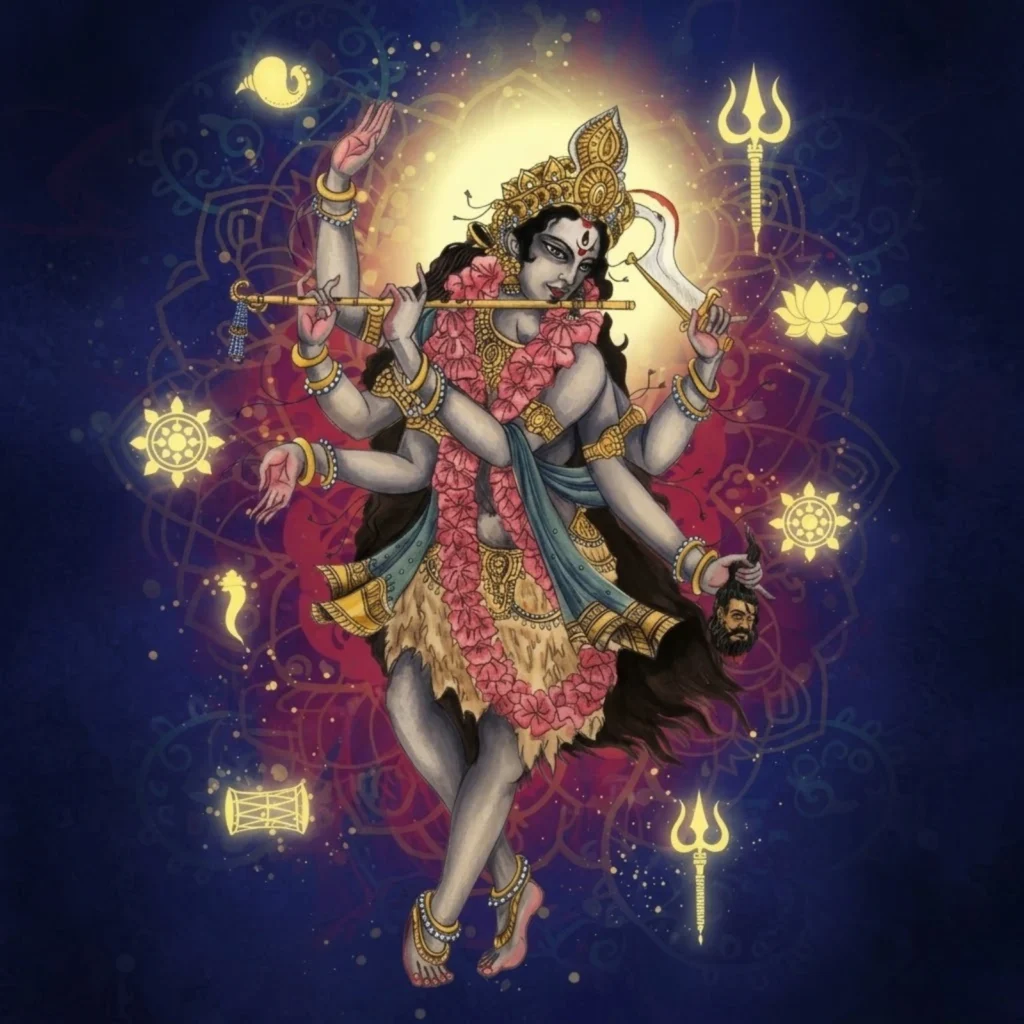
There’s an image that terrifies Western audiences and, increasingly, Westernized Indians: a dark-skinned Goddess with wild hair, tongue lolling out, wearing a garland of severed heads and a skirt of dismembered arms, standing on the prone body of Shiva, holding a sword and a freshly cut head dripping blood.
This is Kali.
And if that description is your only encounter with her, you’ll misunderstand everything.
You’ll think she’s a goddess of evil. Of bloodlust. Of mindless destruction. You’ll assume she represents death in the worst sense violent, chaotic, terrifying.
Colonial interpreters thought exactly that. British officials in 19th-century India associated Kali with the Thuggee cult (a criminal organization the British may have exaggerated or even invented to justify colonial control). They presented her as evidence of Hinduism’s “barbarism” a dark, violent goddess worshipped by violent people.
This narrative has persisted. Hollywood uses Kali as a symbol of malevolence (famously in Indiana Jones and the Temple of Doom). New Age appropriation reduces her to a sexy “dark goddess” archetype divorced from context.
But as I’ve explored throughout my work excavating the Goddess tradition from patriarchal and colonial erasure, what gets labeled “dark” or “fierce” or “dangerous” often challenges power structures that want divinity to be tame, controlled, subordinate.
Kali refuses domestication. And that’s precisely why she matters.
Let me introduce you to the real Kali not the caricature, but the profound theological and psychological force she represents.
What Does Kali Actually Mean?
Kali comes from the Sanskrit root Kala, which means time and also the one who is beyond time. The feminine form Kaali names the consciousness that holds time, governs it, existed before it began, and will remain after it ends. The kali meaning in its deepest register is not darkness as absence. It is darkness as the presence of something so vast and primary that it existed before light was born.
Dark matter and dark energy make up approximately 95 percent of the known universe. Scientists call them dark because they cannot be detected, measured, or seen. They do not absorb, emit, or reflect light. They are invisible to human perception. This is precisely how the tradition describes Kali: the formless, omnipresent. This primordial force is what the tradition names Mahadevi, the primordial force Kali embodies, explored in full in this article. That holds the universe together without being visible to ordinary perception. The Kali goddess meaning in the Shakta tradition is precise and cosmological, not simply iconographic.
What Each Element of Kali’s Appearance Symbolises
The iconography of Kali is not arbitrary. Every element of Kali’s depiction in the iconographic tradition is a philosophical statement. Her dark skin signifies the primordial darkness from which creation emerges, pure potential before any form. Her open, unbound hair signifies her expansion: she cannot be contained or domesticated.
The skull garland (mundamala) carries the letters of the Sanskrit alphabet, all 51 or 52, depending on the tradition, from which all scriptures and all human speech proceed. Her extended tongue is read as: the surprise of stepping on Shiva (having gone further than intended), or the act of consuming demon blood (absorbing what would multiply if it reached the ground). The weapons cut away what obstructs clarity. Her nakedness is her absolute freedom from any framework of definition or limitation.
The Devi Mahatmyam, which describes Kali’s emergence in the tradition’s own words, gives the fullest scriptural account of what her appearance means and what it does in the cosmic narrative.
Kali as Dark Matter: When Ancient Knowledge and Modern Science Arrive at the Same Description
Scientists have established that approximately 27 percent of the universe is dark matter and 68 percent is dark energy, together 95 percent of everything. Dark matter does not interact with electromagnetic radiation: it does not absorb, emit, or reflect light. It is invisible to every scientific instrument currently in use. It defies gravity. It expands continuously.
The Devi Bhagavata Purana, which opens with Mahadevi speaking as Kali, describes herself in terms that map onto this with a precision that is philosophically remarkable. She describes herself as the one who existed before the birth of the universe, who holds it together without being visible, whose expansion will not stop. Two completely different methodologies, one ancient and one modern, arriving at descriptions of the same underlying reality.
Who Is Kali? The Basics
Kali (काली) is one of the most important goddesses in Hinduism, especially within Shaktism (Goddess worship) and Tantra.
Etymology
The name “Kali” derives from the Sanskrit root Kala (काल), which means:
- Time (the force that devours all)
- Death (the end of temporal existence)
- Black/Dark (the void from which creation emerges)
All three meanings are essential. Kali is not just “death” she’s Time itself, the cosmic force that both creates and destroys all things. She’s the Dark Mother from whose infinite womb all existence arises and into which all dissolves.
First Textual Appearance
Kali first appears by name in the Atharva Veda (composed between 1200-1000 BCE), though not yet as a fully developed goddess. Her most famous appearance is in the Devi Mahatmya (6th century CE), where she emerges from Durga’s forehead during the battle against the demon Raktabija.
Later texts particularly Tantric scriptures like the Kalika Purana and philosophical works identifying her as Mahakali develop her theology extensively.
Kali in the Shakta Tradition
In Shaktism, Kali is understood as:
1. A fierce form of the Devi (the supreme Goddess), alongside benevolent forms like Parvati and Lakshmi
2. One of the Ten Mahavidyas (Great Wisdom Goddesses) in Tantric tradition specifically, the first and most powerful
3. Brahman itself (ultimate reality) taking form, according to some philosophical schools
4. Shakti (feminine power/energy) without which even Shiva is inert
She’s not a minor deity. She’s one of the most philosophically and spiritually significant figures in the entire tradition.
The Iconography: What Each Symbol Means
If you see an image of Kali and feel only horror, you’re reading the symbols literally rather than mythologically. Let me decode what you’re actually seeing:
Dark or Black Skin
Literal Western reading: She’s “dark” and therefore evil/frightening.
Actual meaning: Her blackness represents the infinite void, the formless Brahman from which all creation emerges. Black absorbs all colors, symbolizing the totality that encompasses everything. As philosopher Paramahansa Yogananda explained, “In Aum everything exists all matter, all energy, and the thoughts of all conscious beings.”
Her darkness is not moral darkness. It’s the darkness of primordial potential, the cosmic womb.
Garland of Severed Heads
Literal reading: Bloodthirsty violence.
Actual meaning: The heads represent the 50 letters of the Sanskrit alphabet. Together, they symbolize the power of sound and language the mantras through which reality is created and dissolved.
More deeply, the heads are severed egos. Kali destroys the illusion of separate self. Each head is an “I” that believed itself independent, now liberated into recognition of oneness.
Skirt of Dismembered Arms
Literal reading: She kills and dismembers.
Actual meaning: The arms represent karma the accumulated actions that bind souls to the cycle of rebirth (samsara). Kali severs these karmic chains, liberating her devotees from bondage to action and its consequences.
The skirt also symbolizes work/action itself. Kali teaches that ultimately, all actions are hers we are instruments, not independent actors.
Protruding Tongue
Literal reading: Blood lust, savage hunger.
Actual meaning: In Bengali culture, sticking out your tongue signifies embarrassment or shame after making a mistake.
The most common story: Kali, in her battle fury, begins destroying everything good and evil alike. To stop her, Shiva lies down in her path. When she steps on him and realizes what she’s done, she sticks out her tongue in shocked recognition.
Symbolism: Even the fiercest divine power recognizes limits. Consciousness (Shiva) and energy (Shakti/Kali) must work together. When power operates without consciousness, destruction becomes indiscriminate.
Standing on Shiva
Literal reading: She dominates/disrespects her husband.
Actual meaning: This is one of the most philosophically rich images in Hinduism.
Interpretation 1: Shiva represents pure consciousness (Purusha), static and unchanging. Kali represents dynamic energy (Prakriti/Shakti). Without her, he’s inert (shava corpse). Without him, she’s uncontrolled power. Together, they’re complete reality.
Interpretation 2: Kali stands on Shiva at cremation grounds, where practitioners meditate to overcome attachment to the body. This image reminds us that the physical (Shiva’s body) is temporary; what endures is consciousness and energy.
Interpretation 3: In Tantric philosophy, the feminine is supreme. Shiva derives power from Shakti, not vice versa. This image boldly asserts feminine primacy.
The Sword and Severed Head
Literal reading: Weapons of violence.
Actual meaning: The sword is jnana (knowledge/wisdom) that cuts through avidya (ignorance). The severed head is the ego that must die for liberation to occur.
Kali isn’t destroying randomly. She’s destroying what binds us: false identification with the limited self, attachments, fears, ignorance.
Four Arms
Her four arms hold:
- Sword (knowledge)
- Severed head (ego death)
- Abhaya mudra (hand gesture of fearlessness) “Do not fear”
- Varada mudra (hand gesture of blessings) “I grant boons”
The message: Yes, she destroys. But she destroys for you, not against you. She grants fearlessness and blessings to those who surrender.
The Story of Raktabija: Why Kali Is Necessary
To understand Kali’s function, you need to know the demon Raktabija’s story from the Devi Mahatmya:
Raktabija (literally “Blood-Seed”) has a unique power: every drop of his blood that touches the ground spawns a new Raktabija clone of equal strength.
Durga and the gods fight him. They wound him. His blood spills. Instantly, thousands of Raktabijas appear. They wound more. Tens of thousands. The demons are winning by multiplication.
No amount of force can defeat Raktabija. Conventional warfare even divine warfare fails.
Then Kali emerges from Durga’s forehead.
She understands what’s needed: containment before destruction. She holds a bowl to catch the blood, drinks it before it touches ground, preventing replication. She devours every drop. The clones stop appearing. Raktabija is defeated.
Symbolism: Raktabija represents proliferating desire. You kill one craving, two more appear. You satisfy one want, three more arise. Multiplication is the nature of desire left unchecked.
Conventional “warfare” against desire trying to suppress or control it fails. The more you fight desire with willpower, the more it multiplies.
Kali offers a different solution: transformation through consumption. She doesn’t fight desire from outside. She swallows it, metabolizes it, transforms it into power.
This is radical spiritual technology. Not suppression. Not indulgence. But alchemical transformation.
Kali’s Different Forms
Kali manifests in multiple forms, each emphasizing different aspects:
Mahakali (Great Kali)
The most powerful and all-encompassing form. Mahakali is sometimes identified with Brahman itself the ultimate reality. She’s the source of all divine powers, including those of the male gods.
In this form, she may have ten arms, each holding weapons representing the powers of different deities, showing she contains all divine functions.
Dakshina Kali (Benevolent Kali)
This is the form most commonly worshipped in households, especially in Bengal. Dakshina Kali is loving, maternal, protective. She grants boons, removes obstacles, and showers devotees with affection.
This is the Kali that devotees call “Ma” (Mother). She’s fierce toward evil but tender toward her children.
Smashan Kali (Cremation Ground Kali)
The most terrifying form, associated with cremation grounds and Tantric practice. Smashan Kali represents the absolute dissolution of illusion.
Practitioners meditate in cremation grounds specifically to face death, overcome fear, and realize the impermanence of the body. Smashan Kali presides over this radical spiritual practice.
Bhadrakali (Auspicious Kali)
Despite her fierce form, Bhadrakali is protective and auspicious. She’s a warrior goddess who destroys demons and protects devotees.
This form reminds us that fierceness and love aren’t opposites. The mother who fiercely protects her children from danger is expressing love through ferocity.
Kali and Shiva: The Perfect Partnership
The relationship between Kali and Shiva is central to understanding her:
“Shiva Without Shakti Is Shava”
This famous saying means: “Shiva without Shakti is a corpse.”
Shiva represents consciousness pure awareness, unchanging, eternal. But consciousness alone cannot act, create, or transform.
Kali (as Shakti) is energy, power, dynamism. She’s the force that makes consciousness effective in the world.
Together, they’re complete. Apart, Shiva is inert and Kali is ungrounded.
The Dance of Creation and Dissolution
Shiva is famous as Nataraja the cosmic dancer whose movements create and destroy universes.
But Kali dances too. Some images show both Shiva and Kali dancing, sometimes together, sometimes in competition.
The message: Creation/preservation/destruction are not solo acts. They require the interplay of consciousness (Shiva) and energy (Kali).
Tantric Non-Duality
In Tantric philosophy, Shiva and Kali are not two beings but two aspects of one reality.
Like ice and water different forms, same substance. Like wave and ocean apparent separation, actual oneness.
Advanced practitioners meditate on their union (sometimes symbolized sexually as Yab-Yum in Tantric Buddhism) to realize the non-duality of consciousness and energy, masculine and feminine, transcendence and immanence.
Why Kali Has Been Misunderstood
Several factors contributed to Kali’s misrepresentation:
Colonial Interpretations
British colonizers needed to portray Hinduism as barbaric to justify their “civilizing mission.” Kali, with her fierce iconography, became a convenient symbol.
They associated her with:
- The Thuggee cult: A criminal organization the British claimed worshipped Kali. Modern scholars suggest the Thuggees were exaggerated or even invented by the British as propaganda.
- Animal (and alleged human) sacrifice: While goats are sacrificed at some Kali temples, claims of human sacrifice were greatly exaggerated or fabricated.
- “Savage” practices: Tantric rituals involving cremation grounds, sexuality, and transgression of orthodox norms were presented as evidence of Hinduism’s moral backwardness.
The British narrative served colonialism: “These people worship terrifying violent goddesses; they need us to bring Christian morality.”
Patriarchal Domestication
Even within Hindu tradition, there’s been pressure to domesticate Kali make her “safer” for patriarchal comfort.
Some interpretations:
- Emphasize Dakshina Kali (the benevolent form) while avoiding Smashan Kali
- Present her as subordinate to Shiva rather than equal or superior
- Downplay her Tantric associations (since Tantra challenges orthodox Brahmanical authority)
As I’ve explored in my work on the Goddess tradition, this domestication is patriarchal erasure. The fierce Goddess challenges male authority both human and divine so she must be made “nice.”
But Kali resists. She refuses to be tamed.
Western New Age Appropriation
Recently, Kali has been adopted by New Age spirituality, often as:
- A “dark goddess” archetype (shadow work, embracing darkness)
- A symbol of female rage and empowerment
- A tantric sex goddess
While some of this honors her power, much of it strips away context, reducing a complex theological figure to a convenient symbol for Western self-development.
Real Kali devotion isn’t about “embracing your dark side” in a therapeutic sense. It’s about ego death, liberation from the cycle of rebirth, and realizing non-dual awareness.
Kali in Practice: How She’s Actually Worshipped
Let me tell you how real devotees understand and worship Kali:
Ramakrishna Paramahansa and Kali
No discussion of Kali is complete without mentioning Sri Ramakrishna, the 19th-century Bengali saint and devotee of Kali.
Ramakrishna was a priest at Dakshineswar Kali Temple near Kolkata. His devotion was so intense that he would:
- Weep for hours pleading for Kali’s vision
- Refuse to eat until “Ma” (Mother) appeared to him
- Dance ecstatically upon feeling her presence
- Experience mystical visions and states of samadhi (divine absorption)
His relationship with Kali was intimate, maternal, loving. He called her “Ma” the universal Mother who is both fierce protector and tender nurturer.
Ramakrishna’s disciple, Swami Vivekananda, carried his teacher’s message of Kali devotion to the world, helping reclaim her from colonial misrepresentation.
Kali Puja
Kali Puja is celebrated primarily in Bengal, coinciding with Diwali in other parts of India.
The festival involves:
- Clay images of Kali created and worshipped
- Offerings of flowers (especially red hibiscus), sweets, and in some temples, goat sacrifice
- All-night worship with drums, dancing, chanting
- Immersion of the clay images in rivers the next day
Devotees experience this as intimate communion with the Divine Mother. It’s joyful, emotional, intense not fearful or morbid.
Tantric Kali Sadhana
Advanced practitioners perform Kali sadhana (spiritual practice) that includes:
- Meditation in cremation grounds: Facing death directly to overcome attachment to the body
- Panchamakara (five M’s): Ritual use of fish, meat, wine, grain, and sexual union transgressing orthodox taboos to transcend dualistic thinking
- Visualization practices: Imagining Kali dissolving the ego, cutting through illusion
- Mantra repetition: Especially the bija mantras “Krim” (Kali’s seed sound) and longer mantras invoking her presence
This isn’t dark magic or evil worship. It’s a spirituality that uses transgression strategically to shatter limiting beliefs and realize non-dual awareness.
What Kali Teaches Us Today
Even if you don’t practice Hinduism, Kali offers profound insights:
The Necessity of Destruction
We live in a culture obsessed with growth, accumulation, preservation. More, more, more.
Kali says: Sometimes you need less. Sometimes you need nothing. Sometimes destruction is liberation.
Bad relationships need to end. False beliefs need to die. Ego attachments need to be severed. Kali presides over these necessary endings.
Feminine Power Beyond Patriarchal Approval
Kali doesn’t ask permission. She doesn’t soften herself to make others comfortable. She doesn’t apologize for her power.
In an era still struggling with feminine authority, Kali models what undomesticated feminine power looks like. Not “nice” or “polite” but truthful, forceful, sovereign.
Transformation Through Darkness
The culture tells us to “stay positive,” “think light,” “raise your vibration.”
Kali says: No. Enter the darkness. Face your shadow. Die to who you were.
Real transformation happens not by avoiding darkness but by moving through it. Kali is the guide through that darkness fierce, terrifying, but ultimately liberating.
Time Devours All
“Kali” means Time. And Time consumes everything:
- Your youth
- Your plans
- Your accomplishments
- Your relationships
- Your body
- Your life
This isn’t pessimistic. It’s realistic. Kali forces confrontation with impermanence.
And in that confrontation lies liberation. When you realize everything temporal will end, you stop clinging. You stop pretending. You live with more intensity and less illusion.
Conclusion: The Goddess Who Refuses to Be Tamed
Kali will always be misunderstood by those who need divinity to be safe, controlled, domesticated.
She’s too wild. Too fierce. Too uncompromising. Too honest about the darkness that’s inseparable from light, the destruction that’s necessary for creation, the death that’s prerequisite for liberation.
As I’ve argued throughout my work on mythology and its ongoing functions, the narratives and symbols we preserve determine what remains possible to imagine.
Kali preserves the possibility of:
- Feminine divinity that doesn’t require male approval
- Spiritual practice that transgresses respectability
- Liberation through destruction rather than accumulation
- Fierceness as an expression of love
These possibilities threaten power structures colonial, patriarchal, capitalist that want divinity tame and spirituality safe.
So Kali has been misunderstood, demonized, appropriated, and domesticated.
But she endures.
Because some truths cannot be erased. And the truth Kali embodies that real transformation requires real death, that power includes the power to destroy, that the Divine Mother is as fierce as she is loving that truth remains.
Whether we’re ready for it or not.
Why Kali Is Feared, And Why That Fear Is a Misreading
People fear Kali because she does not comfort. She does not offer soft reassurance that desires will be fulfilled and the world is ultimately gentle. She arrives to show the truth that has been avoided, and truth, the tradition acknowledges plainly, is the most terrifying thing in existence.
The comfort of Devi Lakshmi arrives with abundance. The comfort of Devi Saraswati arrives with knowledge. Kali offers neither in the first instance. She offers a clearing. What is cleared is everything that was never real to begin with, the accumulated attachments, the self-images built on avoidance. This looks like destruction from inside. From the perspective of what comes after, it is the only thing that makes genuine creation possible.
Frequently Asked Questions
Kali represents the primordial consciousness that governs time and exists beyond it. Her name is connected with the Sanskrit word kala, meaning time. In the Shakta tradition, she is understood as the formless and omnipresent energy that existed before the universe emerged and that remains after it dissolves. The darkness associated with her does not signify evil or emptiness. It represents a reality so vast and fundamental that it precedes all visible form and light.
Kali’s dark skin represents the primordial darkness from which creation emerges, the state of pure potential before form, distinction, and visible light. It is not a symbol of evil or a lack of beauty. Her complexion points to the infinite and formless reality that contains every possible form without being limited by any one of them. In this symbolism, darkness represents the cosmic ground on which the universe appears.
The skull garland, known as the mundamala, is interpreted in some traditions as representing the letters of the Sanskrit alphabet. These letters are the foundation of mantra, scripture, language, and articulated knowledge. The garland therefore does not simply represent death or violence. It also symbolises the creative power of sound and speech, showing Kali as the source from which language, knowledge, and manifestation proceed.
Kali is not considered evil within Hindu theology. She is more accurately understood as the power of transformation and dissolution. Her fierce imagery represents the removal of ignorance, ego, attachment, and forms that have completed their purpose. In the Indic tradition, dissolution is necessary because it clears the way for renewal and another cycle of creation. What appears as destruction from a limited perspective is understood as a deeper process of liberation, protection, and cosmic balance.
Kali’s extended tongue has several interpretations, especially within Bengali devotional traditions. One widely known explanation is that it expresses sudden awareness or embarrassment after she realises that she has stepped on Shiva. The gesture marks a movement from uncontrolled force to conscious restraint. Rather than representing aggression, it communicates recognition, balance, and the moment in which power becomes aware of its own intensity.
The image of Kali standing on Shiva expresses the relationship between energy and consciousness. Kali represents Shakti, the dynamic power through which existence acts, while Shiva represents pure awareness and the field in which that power operates. Without Shakti, consciousness remains inactive. Without consciousness, energy has no direction. Some interpretations also connect Shiva with time and understand Kali’s position above him as a sign that she is not limited by time. The image describes interdependence, not conflict or hierarchy.
Kali and Durga are forms of the same supreme feminine reality, but they express different dimensions of divine power. Durga is the warrior and protector who enters the cosmic struggle to restore balance and defend dharma. Kali represents a more primordial and formless power that precedes structure and dissolves all limitation. Durga acts within cosmic order to correct imbalance, while Kali represents the deeper ground from which order, transformation, and dissolution arise.
Dakshina Kali is a benevolent and accessible form of Kali who is widely worshipped in temples and domestic settings. Devotees approach her as a compassionate, protective, and responsive mother. Worship may include flowers, incense, lamps, mantra, prayer, and simple offerings according to family or regional tradition. Her form retains Kali’s profound symbolism while emphasising reassurance, grace, and maternal protection.
In Tantric traditions, Kali represents the direct transformative power that dissolves illusion and leads the practitioner toward liberation. Her association with cremation grounds, impermanence, and boundary-breaking imagery reflects a disciplined confrontation with fear, ego, and social conditioning. She is not approached merely as a symbol but as a living spiritual reality within specific practices. Traditional Tantric worship requires proper guidance, preparation, and commitment.
In Bengal, Kali is revered as an intimate and deeply maternal presence. Devotees commonly address her as Ma, expressing trust, vulnerability, affection, and direct personal connection. Poetry, music, temple traditions, household worship, and Kali Puja have strengthened this devotional relationship across generations. Within this cultural setting, her fierce appearance does not make her distant or frightening. She is loved as a protective mother who removes illusion and guides her devotees through change.
Kali’s symbolism addresses modern struggles with identity, control, attachment, fear, and constant change. She represents the courage to confront difficult truths and release patterns that no longer serve a meaningful purpose. Her teachings encourage acceptance of impermanence, freedom from false self-images, and resilience during transformation. In this sense, Kali remains relevant as a symbol of psychological clarity, spiritual courage, and liberation from limiting structures.
Continue Your Journey

About the Author
Priyanka Sharma Kaintura
Priyanka Sharma Kaintura is a mythology writer and speaker dedicated to
excavating narratives, especially feminine ones, that have been buried
by patriarchy and colonialism. After two decades in corporate
communication, she now writes full-time, focusing particularly on
reclaiming the fierce Goddess tradition within Hinduism and challenging
frameworks that domesticate divine feminine power.
Her books include
Mahadevi: The Unseen Truth Behind Existence
and
My Jiffies: Narration of Moments, Unadulterated and Unpackaged
.


