Before there was the Devi Bhagavata Purana. Before elaborate Shakta philosophy systematized Goddess supremacy. Before centuries of theological development positioned the Divine Feminine at the center of cosmic reality.
There was the Devi Mahatmya (देवीमाहात्म्यम्).
700 verses. 13 chapters. Probably composed in the 6th century CE. Embedded within the larger Markandeya Purana.
This text did something revolutionary: it presented the Goddess as the supreme power of the universe not consort, not helper, not support system but the source itself.
And it did so not through abstract philosophy but through narrative. Three epic battles. Three demon armies. Three manifestations of feminine power defeating what all male gods could not.
The Devi Mahatmya (also called Durga Saptashati because of its 700 verses, or Chandi Path after Chandi/Chandika, the fierce Goddess who appears in it) is arguably the single most important text in Shaktism, the tradition that worships Shakti as supreme.
As I wrote in Mahadevi: The Unseen Truth Behind Existence, excavating the Goddess tradition requires understanding where it begins textually. And it begins here.
Let me take you through this revolutionary text.
What Is the Devi Mahatmya?
The Devi Mahatmya is a Sanskrit devotional text that forms chapters 81-93 of the Markandeya Purana, one of the oldest 18 Mahapuranas in Hindu tradition.
Basic Structure
700 verses (hence “Saptashati” = seven hundred) 13 chapters 3 major episodes (called “Charitras”) Composed: Approximately 5th-6th century CE
The text is attributed to sage Markandeya, who recounts these stories to his disciples. Within the frame narrative, two characters King Suratha (who lost his kingdom) and merchant Samadhi (betrayed by his family) seek wisdom from sage Medha about why they still feel attachment to those who wronged them.
Medha responds by telling them about Devi the Goddess who controls even the attachments and delusions that bind us. He then narrates three battles, each progressively more complex, showing different aspects of the Divine Feminine.
Why “Mahatmya”?
“Mahatmya” means “glory” or “greatness.” So Devi Mahatmya = “The Glory of the Goddess.”
The title signals this is not neutral mythology but praise literature. It’s devotional from the start, positioning the Goddess as worthy of highest reverence.
Alternative Names
The text is known by several names:
Devi Mahatmya (most scholarly) Durga Saptashati (emphasizing the 700 verses and Durga’s centrality) Chandi or Chandi Path (“Path/Reading of the Fierce One”) Saptashati (simply “The Seven Hundred”)
Different communities prefer different names, but they all refer to the same text.
The Three Episodes: Battles That Build
The genius of the Devi Mahatmya is its structure. The three battles aren’t random. They’re progressive each reveals more about the Goddess’s nature and power.
Episode 1 (Chapter 1): Mahakali Defeats Madhu and Kaitabha
The first episode is cosmological. It explains how the universe itself came to exist.
At the beginning of a cosmic cycle, Vishnu lies in yogic sleep on the cosmic ocean. Two demons, Madhu and Kaitabha, emerge from the earwax in Vishnu’s ears (yes, really) and threaten Brahma, who is about to begin creation.
Brahma realizes he needs Vishnu awake to defeat the demons. But Vishnu is deep in yoga-nidra (yogic sleep). What keeps him asleep?
Yoga-nidra herself a form of the Goddess called Maha-Maya (Great Illusion).
So Brahma prays to the Goddess residing in Vishnu’s eyes, begging her to withdraw so Vishnu can awaken. She agrees. Vishnu wakes, fights the demons for five thousand years, and finally defeats them.
Theological significance: The Goddess controls even Vishnu’s consciousness. Without her consent, even the Preserver cannot act. She is the power (Shakti) behind the gods’ functions.
This episode introduces us to Mahakali the dark, primordial form associated with time (kala), dissolution, and the power that precedes creation.
Episode 2 (Chapters 2-4): Mahalakshmi as Durga Defeats Mahishasura
This is the most famous episode the story depicted in countless temple carvings, paintings, and Durga Puja celebrations worldwide.
The demon king Mahishasura (whose name literally means “buffalo demon”) conquers the three worlds. He defeats Indra and the other gods, driving them from heaven.
The male gods Brahma, Vishnu, Shiva, Indra, all of them try to defeat Mahishasura. They fail. None of them individually possesses sufficient power.
So they combine their energies. Each god contributes his light/power (tejas):
- From Shiva’s light comes her face
- From Vishnu’s light come her arms
- From Yama’s light come her hair
- From Indra’s light come her waist
- Each god contributes a weapon: Shiva’s trident, Vishnu’s discus, Indra’s thunderbolt, etc.
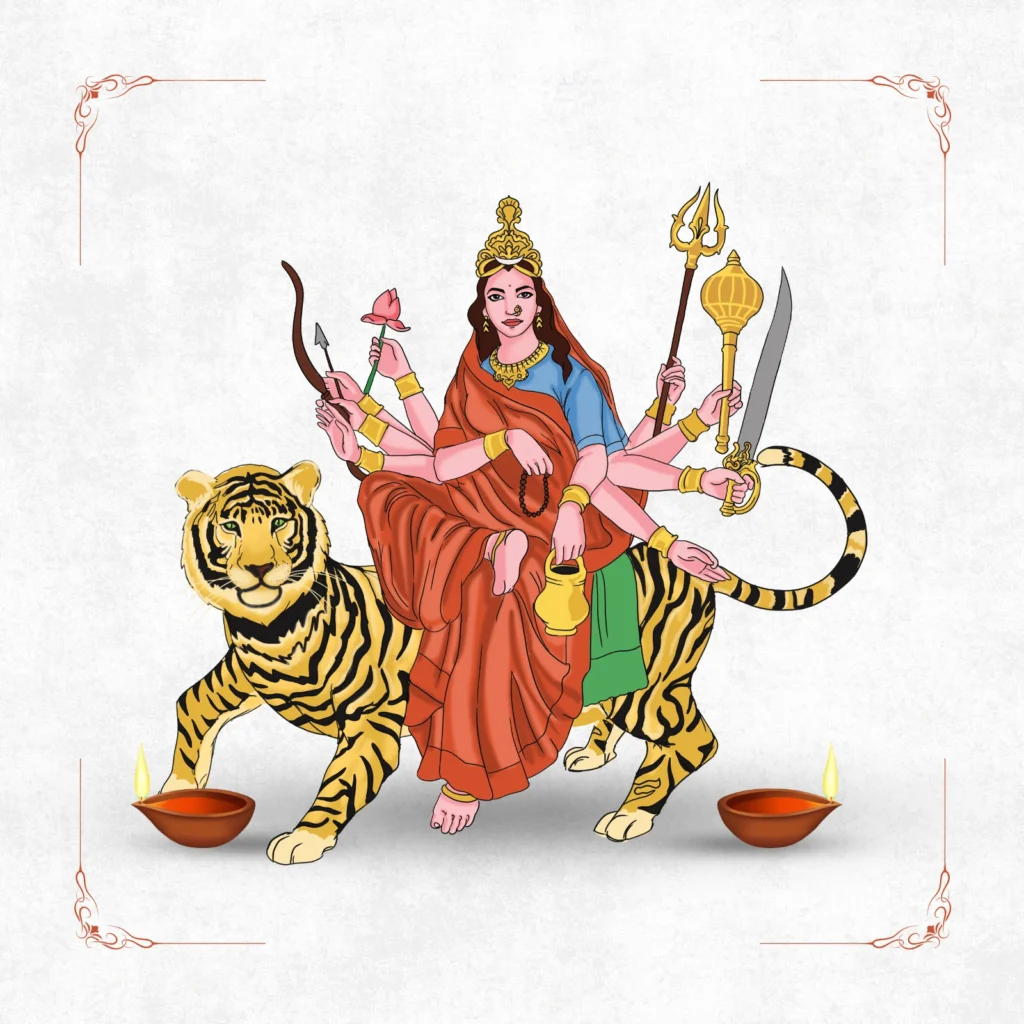
From this combined energy emerges Durga blazing with power, ten-armed, riding a lion, holding every divine weapon.
The battle is fierce. Mahishasura keeps shapeshifting buffalo, lion, man, elephant but Durga matches every form. Finally, she pins the buffalo form with her foot and beheads him with her sword.
Key insight: The male gods create Durga? No. Better reading: they recognize that only by channeling the primordial Shakti feminine power can victory be achieved. Durga is not their subordinate creation. She’s the manifestation of the power that was always greater than their individual powers combined.
This episode introduces Mahalakshmi associated with prosperity, sovereignty, and the concentrated power needed to defeat overwhelming evil.
Episode 3 (Chapters 5-13): Mahasaraswati Defeats Shumbha, Nishumbha, and Raktabija
The third episode is the longest and most complex. Two demon brothers, Shumbha and Nishumbha, conquer the universe. They hear of the Goddess’s beauty and send messengers demanding she marry one of them.
Her response? Basically: “I made a vow long ago that I’ll only marry someone who defeats me in battle. So come try.”
The demons send armies. The Goddess begins multiplying herself:
- Kali emerges from her forehead terrifying, tongue lolling, wearing skulls
- The Saptamatrikas (Seven Mothers) emerge Brahmani, Vaishnavi, Maheshwari, Indrani, Kaumari, Varahi, Chamunda each a feminine counterpart to a male god
Together, they destroy the demon armies.
But then comes Raktabija (“Blood-Seed”) a demon with a unique power: every drop of his blood that touches the ground spawns a new demon clone of equal strength.
The gods are in despair. How do you kill someone whose blood creates infinite duplicates?
Kali solves it. She drinks the blood before it hits the ground, preventing replication. Raktabija is defeated.
Finally, Shumbha and Nishumbha themselves enter battle. Shumbha accuses the Goddess of cheating using helpers (Kali, the Matrikas) instead of fighting alone.
The Goddess responds by absorbing all her emanations back into herself, demonstrating: these aren’t separate beings. They’re all HER. There is only one Goddess, manifesting in multiple forms.
She then defeats both brothers, restoring cosmic order.
Symbolism: This episode shows the Goddess’s infinity. She is one, she is many, she is all. She can manifest countless forms while remaining singular. And her fiercest forms especially Kali are not corruptions but essential aspects of her power.
This episode introduces Mahasaraswati associated with knowledge, speech, and the wisdom that destroys ignorance (symbolized by demons).
The Frame Narrative: Why Are We Hearing This?
Remember King Suratha and merchant Samadhi, who sought sage Medha’s wisdom?
After hearing the three episodes, they perform intense devotion to the Goddess. She appears to them.
Suratha asks for his kingdom back (material boon). Samadhi asks for liberation from worldly attachment (spiritual boon).
The Goddess grants both.
Message: The Divine Mother provides for both material and spiritual needs. She’s not just transcendent (offering moksha) but also immanent (granting worldly boons). This makes the Goddess more accessible than purely transcendent conceptions of divinity.
Philosophy in the Devi Mahatmya
The text isn’t just storytelling. It’s embedded philosophy:
The Goddess as Brahman
Though not as explicit as later Shakta texts, the Devi Mahatmya already identifies the Goddess with ultimate reality.
She is called:
- Maha-Maya: the great illusion/power that governs manifestation
- Maha-Lakshmi: sovereignty and cosmic authority
- Maha-Saraswati: supreme knowledge
- Vishnu-Maya: the power that even Vishnu operates through
- Brahma-Svarupa: of the nature of Brahman
These aren’t metaphors. They’re ontological claims: the Goddess IS ultimate reality taking form.
Shakti as Inseparable from Shiva
The text recognizes that power (Shakti) and consciousness (Shiva/Purusha) are non-dual.
The gods cannot act without Shakti. Their powers are derivative. The source is the Goddess.
Later Shaiva texts will reciprocally declare Shiva supreme, with the Goddess as inseparable Shakti. Both traditions recognize the non-duality, but emphasize different aspects.
The Problem of Evil
Why do demons exist? In the Devi Mahatmya, demons represent:
- Cosmic imbalance: When adharma (unrighteousness) grows excessive, the Goddess manifests to restore balance
- Ego: Mahishasura (buffalo) represents brutish ego. Shumbha represents entitled ego (“she should submit to me”). Raktabija represents proliferating desires.
- Ignorance: Demons are called “asuras” beings without “sura” (light/consciousness). They’re fundamentally ignorant.
The Goddess doesn’t just destroy them physically. She liberates them. In Shakta theology, even demons killed by Devi attain liberation because they’re struck by divine weapons infused with grace.
Why the Devi Mahatmya Changed Everything
Before this text, Goddess worship existed. But it was regional, folk-based, not philosophically systematized.
The Devi Mahatmya did three revolutionary things:
1. It Made the Goddess Supreme (Not Subordinate)
Earlier texts mention goddesses as:
- Consorts: Parvati with Shiva, Lakshmi with Vishnu
- River goddesses: Ganga, Yamuna
- Localized deities: Village goddesses, fertility goddesses
The Devi Mahatmya declares: No. The Goddess is not support staff. She’s the ultimate power. The male gods need HER, not vice versa.
This theological move was radical. It inverted the entire hierarchy.
2. It Gave Shakta Tradition a Canonical Text
Every major tradition needs foundational scripture:
- Vaishnavism had the Bhagavad Gita (Krishna’s teaching)
- Shaivism had Shiva-focused Upanishads and Agamas
- Shaktism needed a text
The Devi Mahatmya became that text. It’s the first complete Sanskrit manuscript devoted entirely to an independent, supreme Goddess.
3. It Inspired Goddess-Centered Art, Ritual, and Philosophy
After the Devi Mahatmya:
- Temples dedicated to the fierce Goddess proliferated
- Durga Puja became a major festival
- Artistic representations of Mahishasuramardini (Durga slaying the buffalo demon) became ubiquitous
- Later philosophical texts like the Devi Bhagavata Purana could build on its foundation
Without this text, Shaktism as we know it wouldn’t exist.
How the Devi Mahatmya Is Used Today
The text isn’t just historical. It’s living scripture, actively used by millions:
Navaratra Recitation
During Navaratra (nine nights of Goddess worship, celebrated twice yearly), devout Shaktas recite the entire Devi Mahatmya. Some complete it in:
- One sitting (Eka-sthana patha): entire text at once
- Three sittings (Tri-sthana patha): Chapter 1 on day 1, Chapters 2-4 on day 2, Chapters 5-13 on day 3
- Seven sittings (Sapta-sthana patha): distributed across seven days
- Nine sittings (Nava-sthana patha): one or more chapters per day over nine days
Ritual Context
The text is rarely read silently. It’s chanted aloud, often with:
- Accompanying stotras (hymns) before and after
- Beej mantras (seed syllables) integrated
- Offerings to the Goddess during recitation
- Visualization of Devi in her various forms
This transforms reading into worship not just intellectual engagement but devotional practice.
Protection and Power
Many believers attribute protective power to the text itself. The 700 verses are considered mantras, not just poetry. Reciting them is believed to:
- Protect from negativity and evil forces
- Grant courage and strength
- Bestow prosperity and success
- Facilitate spiritual liberation
Whether you interpret this literally (the verses have inherent power) or psychologically (devotional focus transforms consciousness), the practical effect is significant for practitioners.
Why This Matters Beyond Religion
Even if you don’t practice Hinduism, the Devi Mahatmya matters because:
It’s Early Feminist Theology
In the 6th century CE when most major religions positioned male divinity as supreme this text insisted ultimate power is feminine.
It depicts a Goddess who:
- Doesn’t need male permission to act
- Defeats enemies male gods cannot
- Operates independently, not as helper
- Embodies both fierce and benevolent aspects
This wasn’t accidental. It was a theological choice that challenged patriarchal assumptions.
It Preserves Alternative Narratives
As I’ve explored throughout my work on how mythology functions and what it actually means, the narratives we preserve shape what remains possible to imagine.
The Devi Mahatmya preserves a vision of divinity feminine, fierce, autonomous, supreme that patriarchal traditions (both indigenous and colonial) have tried to suppress.
By studying, teaching, and taking seriously this text, we keep that vision alive.
It Models Theological Pluralism
The Devi Mahatmya doesn’t demonize other gods. Vishnu, Shiva, Brahma, Indra they all have roles. But they’re not ultimate. The Goddess is.
This creates a hierarchical pluralism: multiple deities exist, but one is supreme. Different Puranic traditions make different choices (Vishnu for Vaishnavas, Shiva for Shaivas, Devi for Shaktas), but all acknowledge the others as real.
This theological model diversity within unity, competing claims of supremacy without rejecting others’ existence offers resources for religious pluralism in a diverse world.
Conclusion: 700 Verses, Infinite Power
The Devi Mahatmya is only 700 verses. You can read it in a few hours.
But those verses changed Hindu Goddess worship forever.
They established the theological foundation for Shaktism. They provided the narrative basis for Durga Puja, India’s most elaborate and beloved Goddess festival. They inspired countless temples, artistic depictions, devotional hymns, and philosophical elaborations.
More importantly, they preserved in the face of patriarchal pressure both within tradition and from colonial interpreters the vision of the Divine Feminine as supreme.
Not because this vision is “better” than Vaishnava or Shaiva alternatives. But because diversity of theological perspectives keeps tradition alive. Because alternatives to male-god-supremacy are necessary. Because the Goddess’s voice deserves to be heard.
As I’ve written throughout my work excavating feminine narratives, what is not named, not centered, not preserved in primary texts disappears.
The Devi Mahatmya ensures the Goddess doesn’t disappear.
And for that reason alone, these 700 verses are worth protecting, studying, and passing on.
Frequently Asked Questions
The Devi Bhagavata Purana stands as a central scripture of the Shakta tradition, distinguished by its unwavering focus on the Goddess as the ultimate reality. Its title signals a sacred narrative devoted entirely to the Divine Feminine, presenting her as both creator and sustaining force of the cosmos. The text is expansive, comprising twelve books and thousands of verses that weave together mythology, philosophy, and ritual instruction. It offers not merely stories but a complete theological system grounded in devotion and metaphysical insight. Its defining claim is that the Goddess alone is the supreme principle behind all existence. In this vision, all other deities derive their power and purpose from her presence.
The text emerged gradually over several centuries, reflecting the evolving prominence of Goddess worship in medieval India. Rather than a single composition, it is a layered work shaped by multiple authors and devotional communities. Scholars typically place its development between the 6th and 14th centuries, aligning it with the broader growth of Puranic literature. Its classification remains debated, revealing deeper theological tensions across traditions. Shakta practitioners regard it as a Mahapurana, granting it canonical authority equal to other major texts. Others classify it as a secondary Purana, often for doctrinal reasons rather than literary ones. By structure and scope, it fulfills the criteria expected of a major Purana.
The text presents a vision in which ultimate reality is not abstract or impersonal but fully embodied in the Divine Feminine. The Goddess is identified with the absolute, simultaneously transcending the universe and pervading it in every form. This perspective unites philosophical non-dualism with devotional intimacy, dissolving the boundary between worshipper and divine. Reality is understood as dynamic and conscious, not static or inert. The world itself becomes an expression of divine energy rather than an illusion to escape. Knowledge of truth involves recognizing this sacred presence within all things. The result is a deeply integrated understanding of existence, where spirit and matter are inseparable.
Most Puranic texts elevate a male deity as supreme, structuring their narratives around his authority and actions. The Devi Bhagavata Purana reverses this orientation, placing the Goddess at the center of all cosmic processes. Creation, preservation, and dissolution are understood as expressions of her power rather than independent divine acts. This shift fundamentally alters the theological hierarchy and the meaning of divine agency. The text also distinguishes itself through its synthesis of rigorous philosophy and devotional fervor. It does not separate metaphysical inquiry from spiritual practice but unites them into a coherent whole. This integration gives it a distinctive voice within the wider Puranic corpus.
The Devi Mahatmya laid the groundwork by presenting the Goddess as the supreme power through vivid and concentrated narratives. The Devi Bhagavata Purana extends this foundation into a far more expansive and systematic framework. It incorporates similar mythic material while embedding it within a broader cosmological and philosophical vision. The earlier text is liturgical and concise, designed for recitation and ritual use. By contrast, the later Purana offers a comprehensive treatment of theology, ethics, and devotion. It situates the Goddess not only as a victorious figure in myth but as the underlying principle of all reality. Together, they form a continuum of Shakta thought and practice.
The Devi Gita serves as a philosophical centerpiece, presenting a dialogue in which the Goddess reveals the nature of reality and the path to liberation. It mirrors the structure of classical spiritual discourses while offering a distinctly Shakta perspective. The Goddess identifies herself as the absolute and outlines multiple paths including knowledge, devotion, and disciplined action. The teaching emphasizes accessibility, affirming that spiritual realization is open to all seekers. Its tone is both instructive and contemplative, blending clarity with depth. The passage has often been studied independently due to its philosophical richness. It stands as one of the clearest articulations of non-dual Goddess theology.
Shaktism understands the Goddess as both the source and substance of the universe, not merely a participant within it. She is the underlying reality that gives rise to all forms, energies, and beings. Every manifestation, whether divine or material, is seen as an expression of her power. This view emphasizes unity, suggesting that multiplicity arises from a single divine essence. The Goddess exists beyond all forms while also inhabiting every aspect of creation. Devotion becomes a means of recognizing this pervasive presence. In this framework, the universe itself is a living expression of sacred feminine energy.
The relative obscurity of the text reflects broader historical and institutional patterns within Hindu traditions. Texts centered on Vishnu or Shiva often received greater patronage, commentary, and transmission. The Devi Bhagavata Purana, with its emphasis on feminine supremacy, did not always align with dominant theological preferences. As a result, it was less frequently translated or promoted in both traditional and modern contexts. Scholarly attention also tended to favor more widely recognized scriptures. However, interest in Goddess traditions has grown significantly in recent decades. This renewed attention is gradually restoring the text to its rightful place within the tradition.
The text offers a comprehensive framework that can support a complete spiritual path centered on the Goddess. It includes philosophical teachings, ritual guidance, and devotional practices woven into a unified whole. Practitioners can draw from it for both daily worship and deeper contemplation. Its teachings are not abstract alone but grounded in lived religious experience. For followers of the Shakta tradition, it serves as a foundational authority comparable to other major scriptures. While guidance from teachers can enrich understanding, the text itself is richly instructive. It invites both intellectual engagement and devotional immersion.
Although composed in a premodern context, the text offers striking theological resources for contemporary feminist reflection. Its central claim that ultimate reality is feminine challenges long-standing assumptions about divinity and authority. The Goddess is depicted as autonomous, creative, and supreme, not defined through dependence on male figures. The text also affirms that spiritual knowledge and liberation are accessible to all, including women. These elements have encouraged modern readers to revisit inherited interpretations and recover alternative perspectives. It does not address social equality in modern terms, yet its metaphysical stance is profoundly suggestive. In this way, it remains a fertile ground for reimagining the role of the feminine in religion.
Continue Your Journey

About the Author
Priyanka Sharma Kaintura
Priyanka Sharma Kaintura is a mythology writer, author, and speaker
dedicated to excavating narratives, especially feminine ones, that have
been buried by patriarchy and colonialism. After two decades in
corporate communication, she now writes full-time, focusing particularly
on reclaiming the Goddess tradition within Hinduism and insisting on the
centrality of the Divine Feminine.
Her books include
Mahadevi: The Unseen Truth Behind Existence
and
My Jiffies: Narration of Moments, Unadulterated and Unpackaged
.


