My childhood was filled with stories of Devi told to me by my grandmother at bedtime; only those were not meant to put me to bed but to awaken something within me, though I did not know it then.
She did not explain the why or the how of anything. She did not interpret. Probably she didn’t even know how to. She simply began with, “once upon a time…” And that was enough, because those stories did not come to me as lessons; they arrived as lasting impressions on the soft mud of my young mind. They settled soundlessly in my core, only to return years later, as reminiscence at times, but mostly as reverence. Respect for my grandmother, respect for the wisdom gently woven in those stories, and respect for my incredibly rich culture are all important to me.
It is only much later that you begin to realize that those stories were never about distant events. They were about states of being. About choices. About responses. About who we become when life demands something of us.
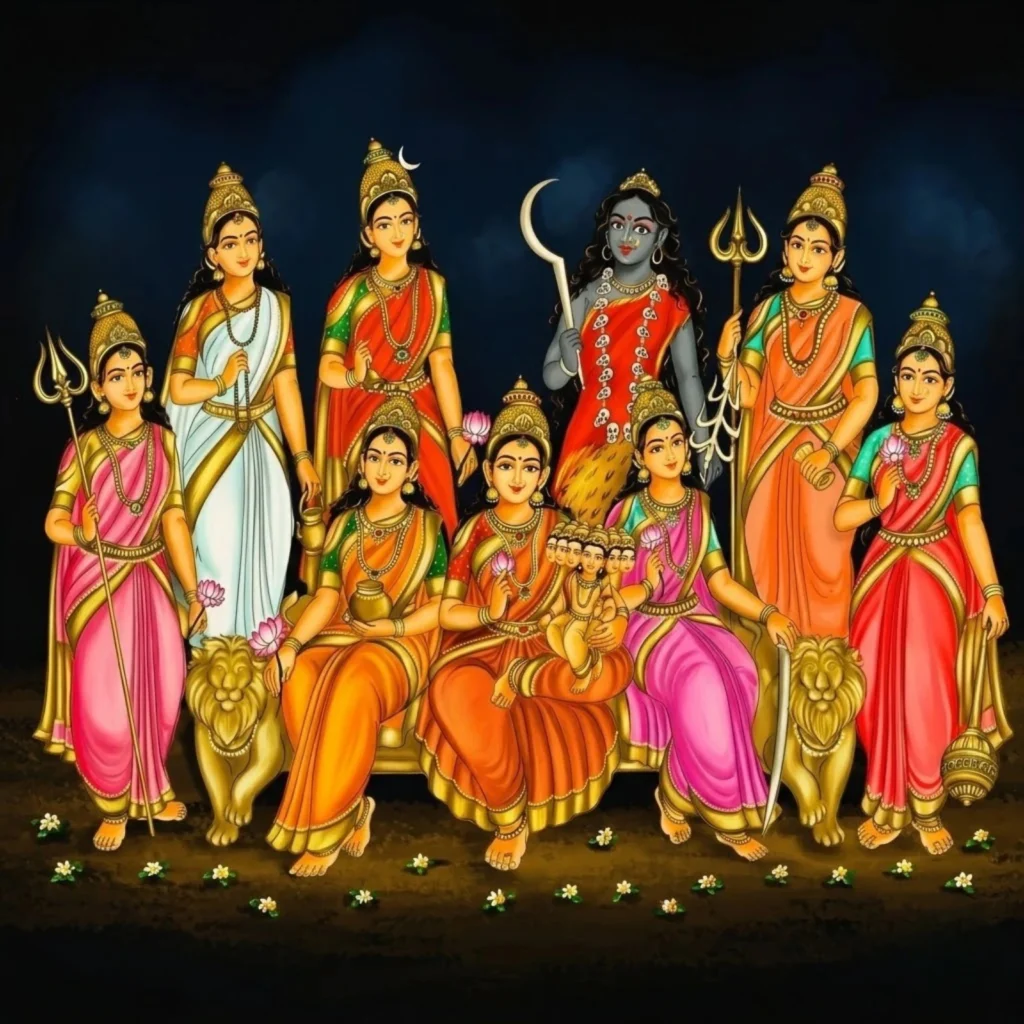
Navratri, in that sense, is not merely a celebration of nine forms. Navratri, in that sense, is not merely a celebration of nine forms – these same forms are encoded with profound depth in the Devi Mahatmya, the scripture that holds all nine. It is an encounter with nine ways of being, each one asking something very precise of us. But somewhere along the way, we made them smaller. We turned them into symbols to admire, from a distance, instead of forces to understand and summon.
Shailaputri
A woman chooses not to respond immediately to a demand, an expectation, or a proposal. Not out of confusion or denial, but because she refuses to be pulled into movement that is not yet hers to make.
Born as the daughter of the Shail – Himalayas, she is the same Sati who returns as Parvati, choosing once again a path that demands both stillness and resolve that does not shift without reason. One should not mistake her either for inertia or an uprising, for she is simply restrained. The ability to hold ground until action becomes aligned, not imposed. But we have reduced her to mere “beginnings,” “the first in the sequence,” or “the first in the journey,” not recognizing that the strength to not move unnecessarily is, in itself, a form of power. She isn’t the beginning, she is the foundation.
Brahmacharini
Someone continues to show up every day – to a practice, a discipline, a path – long after the excitement has faded and before any result has appeared. In her form as Parvati or Aparna or Brahmacharini, she undertakes severe tapasya to attain Shiva. In her excruciatingly long tapasya, she walks with unwavering focus – not for any achievements or desires but for inner alignment. She is not about effort for outcome, but devotion without immediate reward.
We have rewritten her as discipline for success and, many times, success to find a husband, while she actually represents a pursuit that continues even when nothing is promised.
Chandraghanta
A person who speaks firmly, but without agitation. They hold their ground, but without losing composure. Adorned with the crescent moon as well as the battle armor, Chandraghanta holds calmness and alertness within the same breath. At her union with Shiva, Parvati appears as Chandraghanta, serene in presence, yet ever prepared to confront forces that disturb balance.
She is the balance where grace does not exclude strength, and strength does not abandon awareness. But we conveniently separate the two – celebrating softness in one space and force in another, never allowing them to coexist.
Kushmanda
Someone creates – not because the outcome is guaranteed, but because something within them refuses to remain unexpressed.
It is said that in the beginning, when there was darkness, Kushmanda brought forth creation with a subtle smile, expanding the cosmos from within herself. It was creation not through strain but from a center that was already full. She represents creation that begins from consciousness, not external pressure.
In today’s world, recognition, scale, and success are real – and often necessary. But when they become the starting point, creation turns into performance.
Be it cosmos, life, or business, the most enduring creation does not begin with the question “Will this be seen?” It begins with “Does this need to exist?”
Skandamata
A parent, a mentor, or a leader holds space for others not just to protect them but also to prepare another to step into their own strength. As the mother of Skanda (Kartikeya), the commander of divine forces, she holds within her the शक्ति that will go on to lead and protect. She shapes the emergence of power. She is the intelligence that raises strength in another without needing to remain at the center of it.
But we have made nurturing appear passive, taking away the place of power from it, overlooking its role in preparing what is capable of leading and acting.
Katyayani
Someone takes a stand that cannot be softened – where action is no longer optional and avoidance is no longer possible. Born from the combined resources and collective resolve of the gods to defeat Mahishasura and restore balance, Katyayani confronts disorder directly, without hesitation, without dilution.
She is not just decisiveness but the force that meets adharma head-on. Yet we often label such clarity as aggression, choosing comfort over the responsibility of necessary confrontation.
Kalaratri
A phase where nothing feels certain – where what once felt stable begins to fall away, and there is no immediate light to hold on to. In her fiercest form, she destroys asuras like Shumbha and Nishumbha, moving through darkness without hesitation, beheading fear at its source.
She is not the absence of light, but the शक्ति that terminates fear by refusing to turn away from it. But we avoid her entirely, mistaking her intensity for danger and seeking easy escape where transformation is being offered. This same misreading follows Kali – perhaps the most misunderstood goddess in all of Hinduism
Mahagauri
After intensity, after everything unnecessary has been burned away – what remains is simple, clear, and unburdened. After intense tapasya and the grime of wars that leaves her form darkened, Shiva bathes her in Ganga water, and she is restored to a state of radiant clarity, emerging as Mahagauri, transformed through austerity.
Do not mistake her innocence, for she has seen the ways of the universe, but she is purification, the clarity that follows having faced and shed what was heavy. Yet we have reduced her to an image of purity, forgetting the process it takes to arrive there.
Siddhidatri
There comes a moment where nothing more needs to be added – where what exists is complete, not because it is perfect, but because nothing really is lacking.
As the giver of siddhis, she is revered as the one who grants fulfillment and completeness, even to the gods themselves. As the one who grants siddhis, Siddhidatri represents a state of realized completeness, where all aspects are already integrated.
She is fulfilled not because of achievements, but because of wholeness. This understanding of the Goddess as the source of all wholeness is explored more deeply in the Devi Bhagavata Purana – which sees the Goddess as Supreme Reality itself Yet we continue to chase completion outside ourselves, turning what is already present into something endlessly pursued.
Conclusion:
What these nine forms offer is not instruction, they offer reflection. Because the distance is not between us and the Devi. The distance is between what we have been told these forms mean and what they actually point us toward within ourselves. And perhaps that is what those childhood stories were always doing. Not explaining the world to us. But preparing us to recognize ourselves in it.
Frequently Asked Questions
Navratri — literally “nine nights” — is one of Hinduism’s most widely observed festivals, dedicated to the worship of the divine feminine in her nine forms. At its core, it is a festival of transformation: a nine-day journey from darkness toward light, from inner negativity toward higher awareness, from ordinary life toward renewed spiritual purpose. The nine days are not merely a ritual calendar but a map — each day moving the devotee through a different quality of the goddess, and through a different dimension of their own inner life. Navratri teaches that the divine feminine is not a single fixed force but a complete spectrum — capable of nurturing and destroying, creating and purifying — and that true spiritual growth requires moving through all of it.
There are four Navratris observed across the Hindu calendar year. Chaitra Navratri (March–April) marks the Hindu New Year and celebrates spiritual renewal. Sharad Navratri (September–October) is the most widely celebrated, culminating in Dussehra and commemorating Goddess Durga’s victory over the demon Mahishasura — the triumph of righteousness over evil. The two Gupta (hidden) Navratris — Magha and Ashadha — are less publicly observed, followed primarily by serious spiritual practitioners and sadhaks for intensive inner practice. Of the four, Sharad Navratri is considered the most significant, both culturally and spiritually, and is what most people mean when they simply say “Navratri.”
The nine forms — collectively called Navdurga — are Shailputri, Brahmacharini, Chandraghanta, Kushmanda, Skandamata, Katyayani, Kalaratri, Mahagauri, and Siddhidatri. Each represents a distinct aspect of the divine feminine: Shailputri embodies groundedness and strength; Brahmacharini, discipline and devotion; Chandraghanta, courage and protection; Kushmanda, the creative energy of the cosmos; Skandamata, the fierce love of a mother; Katyayani, the warrior’s fierce clarity; Kalaratri, the destruction of all darkness; Mahagauri, purity and inner peace; and Siddhidatri, the fulfillment of spiritual power. Together they form a complete portrait of the goddess — from raw strength to ultimate grace.
The nine forms are not simply nine goddesses to be worshipped in sequence — they represent nine stages of inner transformation. The journey begins with Shailputri, grounding the seeker in the earth and in the body, and moves progressively through discipline, courage, creative awakening, compassion, and warrior clarity, before reaching the dissolution of darkness in Kalaratri and finally arriving at purity and spiritual completeness in Mahagauri and Siddhidatri. Each form asks something different of the devotee — a different quality to cultivate, a different fear to face. The nine days together trace a complete arc of spiritual growth, from where the ordinary human being stands to where the awakened one arrives.
The nine days are traditionally grouped into three triads, each dedicated to a different goddess and a different dimension of the spiritual journey. The first three days belong to Durga — the fierce, purifying energy that removes negativity, destroys inner demons, and clears the ground for growth. The middle three days are dedicated to Lakshmi — the energy of abundance, beauty, and positive cultivation. The final three days honor Saraswati — the goddess of wisdom, knowledge, and creative illumination. This structure reflects a complete sequence: first you clear what no longer serves you, then you cultivate what nourishes you, and finally you open to the wisdom that comes from both. Navratri is not just nine days of worship — it is a deliberately ordered process of transformation.
Nine is considered a number of completeness and cosmic wholeness in Hindu tradition. It is the last single digit — the number that contains all others within it — and is associated with the Brahman, the ultimate reality that underlies all existence. Nine days allow each of the nine forms of the goddess her full day of presence and worship, and they mirror the nine-month cycle of gestation, suggesting that spiritual transformation, like physical birth, cannot be rushed. The structure of Navratri insists that growth takes time — that moving from the first form to the ninth is a genuine journey, not a shortcut. The nine days are the minimum the tradition considers necessary for a complete inner passage.
Continue Your Journey

About the Author
Priyanka Sharma Kaintura
Priyanka Sharma Kaintura is a mythology activist, author, and speaker who explores the deeper spiritual and symbolic meanings behind sacred traditions like Navratri. Through her work, she brings clarity to the significance of the nine forms of Devi, blending scriptural insight with cultural context and modern interpretation.
Her writings decode ancient narratives to help readers connect with the divine feminine in a more meaningful and conscious way. Her books include Mahadevi: The Unseen Truth Behind Existence and My Jiffies: Narration of Moments, Unadulterated and Unpackaged.