From injustice and wounded pride to the failure of leadership, the Mahabharata offers a timeless lens on how societies slide into conflict.
Every generation believes it has become more rational than the last. We build institutions, draft treaties, and develop sophisticated theories of diplomacy, convinced that modern systems have finally moved humanity beyond the brutal cycles of the past. And yet, time and again, civilizations return to the same destination: war. Technology changes, weapons become more precise, and battlefields more complex, but the impulses that lead societies into conflict remain remarkably unchanged. In moments like the present, when global tensions once again dominate headlines, this observation feels particularly difficult to ignore. Long before modern geopolitics attempted to explain war through strategy and economics, the Mahabharata examined it through a far more uncomfortable lens – human nature.
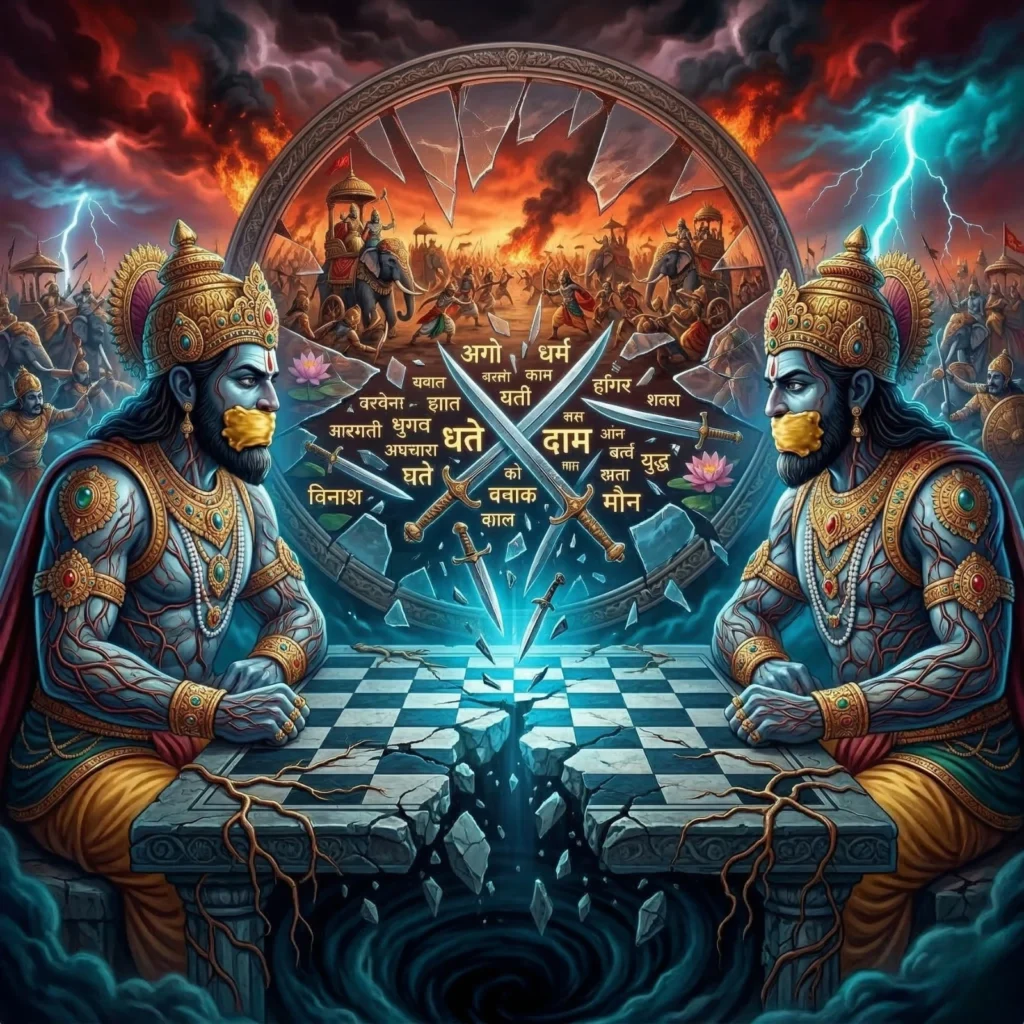
In the Mahabharata, war does not erupt suddenly on the plains of Kurukshetra. It emerges through a chain of human failures – pride that refuses compromise, leadership that hesitates when firmness is required, and the gradual erosion of justice within institutions meant to uphold order. The catastrophe of war, the epic suggests, is rarely invisible. It gathers slowly through choices that could have been corrected and warnings that go unheeded.
One of the earliest fault lines in the epic is the collapse of fairness itself. The conflict between the Kauravas and the Pandavas intensifies when rightful order is quietly undermined – first through manipulation, and then through public humiliation. The infamous game of dice does not merely strip Yudhishthira of his kingdom; it reveals how fragile institutions become when power begins to override justice. What follows in the royal court – the attempted disrobing of Draupadi and the uneasy silence of those who should have intervened – marks a decisive moral rupture. In that moment, the crisis is no longer about territory or succession. It becomes something deeper: a breakdown of dignity, authority, and the systems meant to protect them. It becomes a crisis of justice itself. History shows that once dignity is publicly violated and institutions fail to intervene, conflicts rarely remain contained to the moment, they begin to shape the destiny of nations.
Alongside this injustice, another powerful force begins to take shape – resentment hardened into entitlement. Duryodhana’s hostility toward the Pandavas is not simply political rivalry; it is rooted in a deep insecurity about legitimacy and power. The admiration the Pandavas command – their skill, their character, their growing influence – only sharpens his sense of threat. Over time, this insecurity transforms into an absolute refusal to concede even the smallest compromise. Negotiation becomes impossible, not because solutions are absent, but because pride reframes every concession as humiliation.
Yet personal resentment alone rarely plunges civilizations into war. Catastrophe becomes possible when leadership fails to restrain destructive impulses. Dhritarashtra, the blind king of Hastinapura, is not unaware of the dangers unfolding around him. He hears the warnings of Vidura and Bhishma, who recognise the path toward disaster. But his attachment to his son prevents him from acting decisively. By allowing injustice to stand and resentment to grow unchecked, leadership transforms a private rivalry into a crisis that engulfs an entire kingdom.
Perhaps the most remarkable insight of the Mahabharata emerges at the very moment war becomes unavoidable. Arjuna, the greatest warrior among the Pandavas, collapses at the threshold of battle. Faced with the prospect of fighting teachers, relatives, and friends, he finds himself unable to reconcile duty with the devastation that lies ahead. His hesitation reveals a truth often absent from modern discussions of conflict – even when war becomes necessary, its moral weight remains immense. The dialogue that follows in the Bhagavad Gita is not a celebration of war but a meditation on responsibility in circumstances where every available path carries consequences.
Although the Mahabharata unfolds on the scale of kingdoms, the dynamics it reveals are not unfamiliar in smaller human settings. Families fracture, institutions weaken, and communities polarize through a similar sequence – perceived injustice, wounded pride, silence in the face of wrongdoing, and eventually the collapse of dialogue. What the epic presents on a civilizational scale often begins quietly within everyday human relationships.
The Mahabharata understood something modern politics often forgets – wars do not begin when armies move. They begin when injustice is tolerated and pride refuses restraint. In different forms and in different regions, the world continues to witness how these forces – injured pride, unresolved injustice, and hesitant leadership – can slowly push societies toward confrontation.
Modern discourse often treats mythology as distant narrative, something belonging to the cultural imagination rather than to serious reflection on human affairs. Yet the enduring power of the Mahabharata lies precisely in its refusal to simplify conflict. It presents war not as a sudden eruption of violence but as the final consequence of long-ignored moral failures. By the time armies assemble and battle becomes inevitable, the deeper causes have already been unfolding for years – in choices made, injustices tolerated, and truths left unspoken.
Perhaps that is why every age that believes it has outgrown the past eventually rediscovers the same uncomfortable truths about human nature. Wars rarely begin when the first weapon is raised. They begin much earlier – when injustice is tolerated, pride refuses restraint, and leadership hesitates at the moment it must act.
Frequently Asked Questions
The Mahabharata offers a remarkably nuanced portrait of human nature by exploring the full range of human emotions and motivations. It presents individuals driven by ambition, jealousy, love, fear, loyalty, and pride, often simultaneously. Rather than dividing characters into simple categories of good and evil, the epic shows that every person is a mixture of virtue and flaw. This layered portrayal reflects how real human psychology operates, with constant internal negotiation between competing impulses. The narrative demonstrates that decisions are rarely made in moral clarity but within tension and ambiguity. As a result, the Mahabharata functions as both a story and a psychological study of the human condition.
The Mahabharata is often described as a mirror because it reflects the full spectrum of human behavior without idealization. It captures ambition, loyalty, betrayal, sacrifice, and moral confusion with striking realism. The situations faced by its characters resemble dilemmas people encounter in everyday life, making the epic deeply relatable across time. It shows that individuals are shaped not only by principles but also by circumstance and emotion. This realism allows readers to recognize their own struggles within the narrative. In doing so, the text becomes less a distant myth and more a reflection of lived human experience.
The Kurukshetra war was not triggered by a single event but by a buildup of unresolved psychological tensions. Envy, insecurity, wounded pride, and a deep desire for power all contributed to the conflict. Characters like Duryodhana embody how unchecked jealousy can distort perception and justify destructive choices. Failures in communication and repeated missed opportunities for reconciliation further intensified the situation. Over time, personal grievances hardened into collective hostility. The war thus emerges as the inevitable outcome of long-standing emotional and psychological imbalance.
The Mahabharata treats moral dilemmas as central to human life rather than as exceptions. Characters are frequently placed in situations where every available choice carries ethical consequences. The concept of dharma is shown to be complex, contextual, and often difficult to interpret. Rather than offering fixed rules, the epic encourages thoughtful discernment and self-awareness. Even the most righteous characters struggle to determine the correct course of action. This portrayal underscores that morality is lived through difficult decisions rather than abstract ideals.
Emotions in the Mahabharata are powerful forces that shape both individual choices and collective outcomes. Anger leads to impulsive actions, jealousy breeds conflict, and unchecked desire distorts judgment. Ego, in particular, is portrayed as a central cause of downfall, preventing reconciliation and clouding reason. These emotions are not condemned outright but shown as natural aspects of human nature. The danger arises when they are left unexamined and uncontrolled. Through its characters, the epic illustrates the necessity of inner discipline and emotional awareness.
The Mahabharata presents the human mind as a battlefield where opposing impulses constantly struggle for dominance. Characters experience tension between duty and desire, courage and fear, loyalty and justice. These inner conflicts often precede external events, shaping actions and consequences. The epic suggests that the real war is fought within the individual before it manifests in the world. This psychological depth gives the narrative enduring relevance. It portrays self-mastery as the foundation of ethical action.
The Mahabharata emphasizes that no individual is entirely free from weakness. Even the most virtuous characters display moments of doubt, error, or moral compromise. This portrayal reflects the inherent complexity of human nature. People evolve through their experiences, learning from both successes and failures. The epic avoids simplistic judgments, instead presenting growth as a gradual and often painful process. In doing so, it encourages humility and a deeper understanding of oneself and others.
The Kurukshetra war can be interpreted as a symbolic representation of the inner struggle within every human being. It reflects the conflict between higher values such as duty and truth, and lower impulses like greed and ego. Each character can be seen as embodying different aspects of the human psyche. The battlefield becomes a metaphor for the mind, where choices determine the direction of one’s life. This interpretation adds depth to the narrative beyond its historical or mythological context. It transforms the epic into a guide for self-understanding.
The characters of the Mahabharata can be understood as symbolic representations of different psychological tendencies. Some embody discipline and wisdom, while others reflect desire, ego, or emotional conflict. Their interactions illustrate how these forces coexist and compete within the human mind. This symbolic reading allows the epic to function as a map of consciousness. It reveals how internal dynamics shape external behavior. Such an interpretation deepens the philosophical and psychological significance of the narrative.
The Mahabharata remains relevant because the fundamental aspects of human nature have not changed over time. Emotions such as ambition, fear, jealousy, and love continue to influence human decisions today. The ethical dilemmas faced by its characters mirror those encountered in modern life. Its exploration of power, relationships, and morality resonates across cultures and generations. By addressing universal psychological patterns, the epic transcends its historical context. It continues to offer insight into the complexities of human behavior in any era.
Continue Your Journey

About the Author
Priyanka Sharma Kaintura
A mythology activist, author, and speaker exploring how ancient texts and modern archaeology inform each other. Her books include Mahadevi: The Unseen Truth Behind Existence and My Jiffies: Narration of Moments, Unadulterated and Unpackaged.