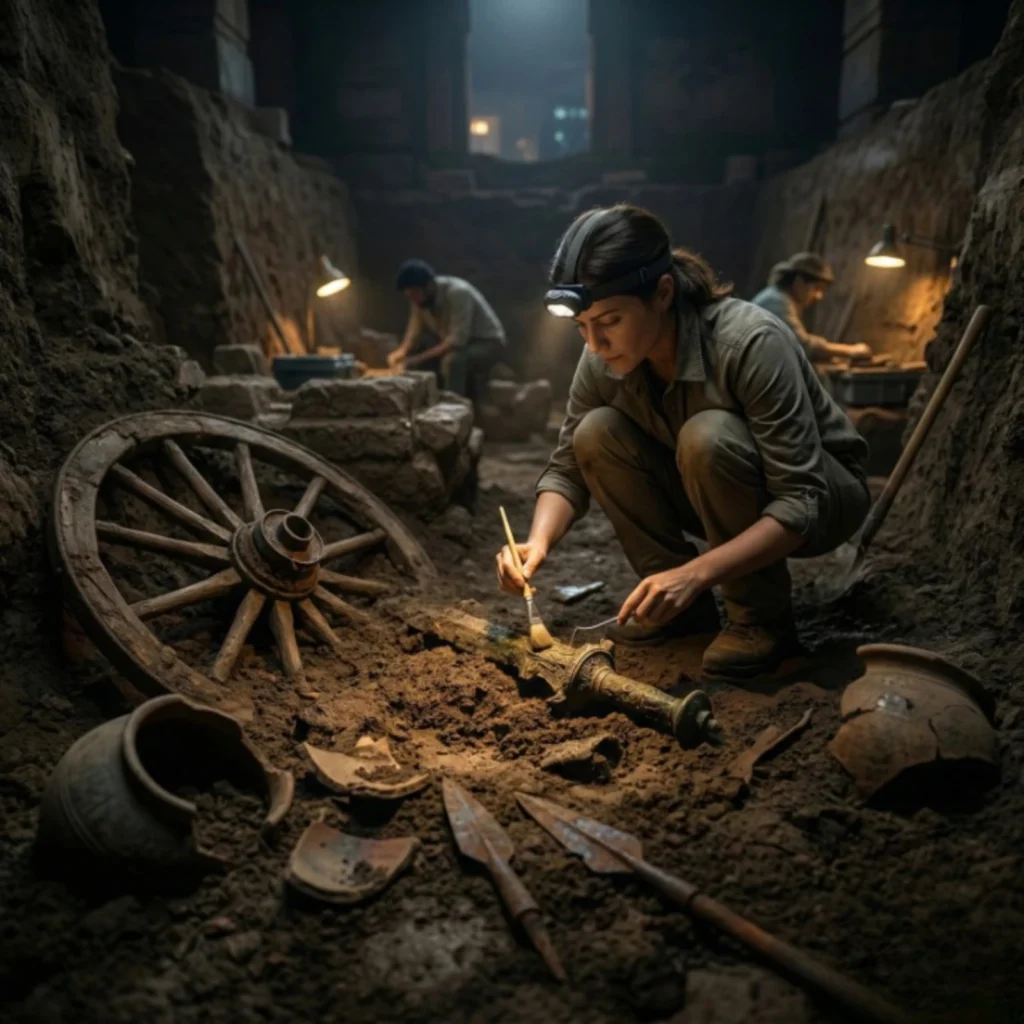
In my previous article, I explored why asking “is Indian mythology real?” is often the wrong question one that smuggles in colonial assumptions about what counts as “real.”
But there’s a legitimate question beneath that problematic framing:
What physical evidence exists for the events described in the Mahabharata?
This isn’t about proving devotion right or skeptics wrong. It’s about examining what archaeology the science of recovering and analyzing material remains has actually uncovered at sites mentioned in India’s greatest epic.
The answer turns out to be fascinating and complex.
There IS archaeological evidence. Real discoveries. Underwater cities. Iron weapons. Pottery. Flood layers. Carbon dating that roughly aligns with textual claims.
But and this matters the evidence doesn’t “prove the Mahabharata happened exactly as written.” What it shows is more nuanced: core elements of the narrative correspond to real places, real cultures, and possibly real conflicts, heavily elaborated over centuries with religious, philosophical, and literary elements.
Let me take you through what’s been found, what it means, and what honest scholars not ideologues on either side actually conclude.
What Archaeological Evidence Exists for the Mahabharata War?
The Mahabharata real evidence available to researchers comes primarily from three sites named in the text: Hastinapur, the Kurukshetra region, and the underwater ruins at Dwarka. This article examines the mahabharat real proof available through archaeological and scientific research, presenting the findings without overclaiming what they establish. The evidence is significant. It is also, by the nature of ancient history, incomplete.
For the fuller philosophical argument about how the Indian tradition distinguishes mythology from history at the epistemological level, this article covers the ground in full.
The Hastinapur Excavations: What B.B. Lal Found
The evidence of Mahabharata in Hastinapur was formally documented by archaeologist B.B. Lal between 1950 and 1952. Hastinapur in Uttar Pradesh is the Kuru capital throughout the Mahabharata. Lal found Painted Grey Ware occupation layers (associated with 1100–600 BCE in the Gangetic plains) and a significant flood layer matching the Mahabharata’s account of Hastinapur being abandoned due to flooding after the war. Published in Ancient India journal in 1954, these findings establish that Hastinapur was a real, inhabited site during the relevant period.
Evidence at Kurukshetra: What Surveys Have Found
The kurukshetra war proof available through archaeological surveys includes iron artefacts and surface finds from the Kurukshetra region of Haryana. The evidence of Mahabharata in Kurukshetra includes iron arrowheads and spearheads found in the region, consistent with Iron Age armed activity approximately 1000–800 BCE.
The Kurukshetra archaeological findings from surface surveys do not prove a specific eighteen-day war. They establish that the region was a site of significant armed activity during the period the tradition associates with the Mahabharata events, and that the name Kurukshetra itself is referenced in multiple ancient texts outside the Mahabharata, confirming its significance as a real geographical and cultural location.
The Dwarka Underwater Excavations: Connection to the Mahabharata
The National Institute of Oceanography of India conducted underwater excavations off the Dwarka coast in the 1980s and 1990s. Submerged stone walls, structures, and artefacts were found at depths consistent with gradual submersion over millennia. Carbon dating produced dates ranging from approximately 1500 BCE to 3000 BCE.
Dwarka is identified in the Mahabharata as the capital city of Krishna, which the tradition says was submerged by the sea after his departure. The Dwarka findings, combined with the Hastinapur and Kurukshetra evidence, form the core of the corroborative archaeological record for the Mahabharata tradition.
The question of whether Krishna existed as a historical figure, the Dwarka evidence addresses this directly and is covered in full in this article.
Site 1: Kurukshetra – The Battlefield Itself
Kurukshetra, in modern Haryana, is where the 18-day war between Pandavas and Kauravas occurred. The Mahabharata describes it as “Dharmakshetra” the field of dharma where cosmic order was restored through battle.
What Excavations Found
Archaeological work at Kurukshetra has yielded:
Iron Weapons:
- Arrow and spearheads
- Fragments of swords and axes
- Chariot remains
Dating: Thermoluminescence testing dates these artifacts to approximately 2800-3100 BCE (various studies yield slightly different dates).
Pottery: Painted Grey Ware (PGW) a distinctive pottery style associated with Late Vedic culture found extensively.
Cultural Layer: Evidence of large-scale habitation and, potentially, significant conflict.
What This Tells Us
The artifacts confirm:
- Major settlement existed where the text says it did
- Warfare occurred in the region (weapons aren’t ceremonial they show battle damage)
- Timeframe is plausible (Late Vedic period aligns with traditional dating, though not conclusively)
What it DOESN’T prove:
- That characters named Arjuna or Krishna personally fought there
- That the war lasted exactly 18 days
- That divine weapons (astras) or supernatural events occurred
Scholar B.B. Lal’s assessment:
“The Mahabharata describes a war at Kurukshetra. Archaeological evidence shows Late Vedic settlements and warfare artifacts exactly where described. A core historical conflict likely occurred, later mythologized.”
Site 2: Hastinapur – Capital of the Kuru Dynasty
Hastinapur, located between Meerut and Mawana in Uttar Pradesh, was the Kuru kingdom’s capital the throne contested between Pandavas and Kauravas.
The 1952 Excavations
Archaeologist B.B. Lal led excavations at Hastinapur (1950-52), uncovering:
Five Cultural Layers: Period I: Pre-1200 BCE Period II: 1200-800 BCE (Painted Grey Ware culture CRITICAL) Period III: 600 BCE-200 CE Period IV: 200 CE-300 CE (Kushan period) Period V: Medieval period
Key Discoveries in Period II (PGW):
- Copper utensils
- Iron seals
- Gold and silver ornaments
- Terracotta discs
- Ivory dice (oblong-shaped, used in the game of chauper the dice game where Yudhishthira lost his kingdom!)
Structural Remains:
- Vidurka Tilla (believed to be Vidura’s palace)
- Draupadi Ki Rasoi (Draupadi’s kitchen)
- Drainage systems indicating urban planning
- Building foundations
The Flood Evidence
Here’s where it gets really interesting.
The Mahabharata and Puranas describe a catastrophic flood in the Ganga that destroyed Hastinapur, forcing King Nichakshu (five generations after the war) to shift the capital to Kausambi.
Excavations found: A thick clay layer between cultural periods clear evidence of massive flooding that disrupted civilization.
The flood layer separates PGW culture from later periods, matching textual descriptions of devastation forcing abandonment.
What This Tells Us
Hastinapur evidence shows:
- Major urban center existed during the Late Vedic period
- Cultural continuity with artifacts matching descriptions (dice game!)
- Catastrophic flood occurred exactly as texts describe
- Geographical precision in the narrative (Mahabharata’s city locations are accurate)
This doesn’t prove Draupadi cooked in that specific kitchen. But it proves:
- The city existed
- It was significant
- It suffered the flood the texts describe
- Cultural details (games, crafts, urban structure) align with the narrative
Site 3: Dwarka – Krishna’s Sunken City
This is perhaps the most dramatic archaeological find related to the Mahabharata.
The epic describes Dwarka as Krishna’s magnificent coastal capital. After Krishna’s death, the Mahabharata explicitly states: “The ocean flooded Dwarka… Whatever portion of land was passed over, the ocean immediately flooded over with its waters.”
For centuries, this was dismissed as poetic metaphor.
Then marine archaeology began.
The Underwater Discoveries
In the 1980s-90s, Dr. S.R. Rao (Archaeological Survey of India) led underwater expeditions off the coast of Gujarat near modern Dwarka.
Massive structures submerged in the Arabian Sea:
- City walls (up to 6 meters thick in places)
- Bastions and fort walls
- Large door-socket
- Harbor structures
- Two rock-cut slipways of varying widths
- Stone anchors (indicating active port)
- Pottery (distinctive Lustrous Red Ware)
Three-headed conch seal: Matches description in Harivamsa text that every Dwarka citizen should carry such a seal.
Dating: Carbon-14 testing of organic materials yielded dates around 1500 BCE (roughly 3500 years ago).
Dr. S.R. Rao’s Conclusion
“The discovery of the legendary city of Dwarka is an important landmark in the history of India. It has set to rest doubts about the historicity of the Mahabharata and the very existence of Dwarka city. It has greatly narrowed the gap in Indian history by establishing continuity of Indian civilization from Vedic Age to present day.”
Skeptical Counterpoints
Some archaeologists remain cautious:
- Alok Tripathi (superintending archaeologist) couldn’t definitively conclude these were Krishna’s Dwarka specifically, noting some structures may be medieval
- Natural geological formations can resemble human construction
- Carbon dating of submerged sites is complex
What This Tells Us
The underwater Dwarka evidence shows:
- Ancient coastal city existed where text describes it
- Major port infrastructure (not just village)
- Submergence occurred (matches narrative claim)
- Approximate dating aligns with Mahabharata period estimates
What’s NOT proven:
- That Krishna personally ruled there
- That it was specifically THE Dwarka of the text (could be earlier/later settlement)
- Exact cause of submergence (natural disaster? Sea level rise? Earthquake?)
Bottom line: Something significant is underwater where the Mahabharata said a city would be. That’s remarkable.
Site 4: Indraprastha – Modern Delhi
The Mahabharata describes Indraprastha as one of three cities given to the Pandavas. Scholars identify it with Purana Qila in modern Delhi.
Archaeological Finds
Excavations at Purana Qila uncovered:
- Painted Grey Ware pottery (same culture as Hastinapur, Kurukshetra)
- Building structures with drainage systems
- Antiquities consistent with Late Vedic period
- Cultural continuity showing ancient habitation
Additionally: Panipat (Paniprastha) and Sonipat (Sonaprastha) the other two cities given to Pandavas show similar archaeological profiles.
Significance
The geographical precision is striking. The Mahabharata doesn’t just name random places. It describes a specific political geography of Late Vedic North India and archaeological evidence confirms urban centers existed exactly where described.
Site 5: Sanauli – Chariots and Royal Burials
In 2018, excavations at Sanauli (Uttar Pradesh) uncovered something extraordinary:
Royal chariot burials with:
- Copper-plated wooden chariots
- Helmets and shields
- Antenna swords
- Royal burial practices
Dating: ~2000 BCE (even earlier than conservative Mahabharata dating).
Why This Matters
The Mahabharata extensively describes chariot warfare vehicle construction, battle formations, charioteer protocols.
Sanauli proves:
- Chariots existed in ancient North India
- Royal warrior culture practiced elaborate burials
- Material culture matches textual descriptions
- Earlier than expected (pushes back Mahabharata’s possible historicity)
Archaeologist B.B. Lal revised his Mahabharata dating to 1500-2000 BCE based partly on Sanauli findings.
Site 6: The Saraswati River – The Lost River
The Mahabharata frequently mentions the Saraswati River as a mighty waterway.
For generations, scholars dismissed this as mythical no such river exists in modern India.
Then satellite imagery and geological surveys found:
- Dried riverbed matching Saraswati’s described course
- Geological evidence of river active 6000-2000 BCE
- Archaeological sites along the ancient banks
The river dried up due to tectonic shifts but it was REAL.
Significance
The text describes geographical realities that no longer exist. This suggests:
- Compositions date to when the river still flowed
- Or preserve accurate memories from that era
- Either way, it’s not pure invention
What About the 35+ Other Sites?
Archaeologists have identified over 35 sites mentioned in the Mahabharata that show:
- Painted Grey Ware pottery (cultural marker)
- Late Vedic period habitation
- Geographical consistency with the narrative
These aren’t random. They form a coherent archaeological culture matching the Mahabharata’s described world.
The Dating Debate: When Did This Happen?
This is where things get contentious.
Traditional/Astronomical Dating
Based on planetary positions described in the text:
- 3102 BCE (most common traditional date)
- Some calculations yield dates as early as 3138 BCE
Archaeological Dating
Based on pottery and artifacts:
- 1500-1000 BCE (most conservative estimates)
- Some evidence (Sanauli, Dwarka) pushes toward 2000 BCE
Why the Discrepancy?
Possible explanations:
- Composition over centuries: Core events earlier, final text much later
- Astronomical descriptions symbolic: Not meant as precise historical markers
- Multiple traditions merged: Different chronologies combined
- Archaeological gaps: We haven’t found the earliest layers yet
Most scholars’ middle ground: A historical core event (likely around 1000-1500 BCE) was elaborated over centuries, with astronomical and genealogical details added that push dates back further.
What Honest Scholars Actually Say
Let me quote several perspectives:
B.B. Lal (Archaeologist):
“Painted Grey Ware sites correlate remarkably with Mahabharata geography. A dynastic conflict likely occurred, later mythologized.”
Dr. S.R. Rao:
“Underwater Dwarka establishes continuity of Indian civilization and historicity of core Mahabharata elements.”
Academic consensus (per Snopes fact-check):
“Archaeological evidence suggests kingdoms and conflicts described in the Mahabharata have historical foundations, heavily elaborated with religious and philosophical elements over centuries of transmission.”
Critical historians maintain:
- No contemporary inscriptions name Mahabharata characters
- Supernatural elements remain unverifiable
- Text composed/edited over long period
What the Evidence DOESN’T Prove
Let’s be clear about limitations:
NOT proven:
- That Krishna, Arjuna, Draupadi, etc. were real historical individuals
- That divine weapons (Brahmastra, etc.) existed
- That the war lasted exactly 18 days
- That every detail of the narrative is historically accurate
- That supernatural events occurred as described
What IS suggested:
- Real kingdoms existed where the text describes
- Significant conflict(s) occurred in the region
- Cultural details (games, crafts, city names) are accurate
- Geographical precision indicates local knowledge, not invention
- Core narrative may preserve memory of historical events
The Intelligent Middle Ground
As I argued in my previous piece, the “real or fake” binary is colonized thinking.
The archaeological evidence supports a third way:
The Mahabharata is Itihasa “thus it happened” meaning:
- Historical memory of real kingdoms and conflicts
- Elaborated with philosophical discourse
- Enhanced with religious significance
- Transmitted through oral and written tradition over centuries
- Serving multiple functions: historical, ethical, spiritual, literary
This is neither “modern history” (doesn’t meet historiographic standards of documentation) nor “pure myth” (too much correlation with physical evidence).
It’s a third category that deserves engagement on its own terms.
Why This Matters Beyond Academics
The archaeology matters for several reasons:
1. Cultural Vindication
For Indians who felt their traditions dismissed as “mythology” by colonial and Western academics, archaeological evidence provides vindication that their sacred narratives preserve real historical memory.
2. Civilizational Continuity
The evidence establishes that Indian civilization has continuity spanning thousands of years not a rupture between “mythical” and “historical” periods.
3. Knowledge Systems
It challenges Western monopoly on defining what counts as valid historical knowledge. Indigenous categories like Itihasa are legitimate frameworks for preserving the past.
4. Contemporary Politics
Unfortunately, archaeological evidence gets weaponized by Hindu nationalists for political purposes claiming “purity” of ancient Hindu civilization, justifying contemporary exclusions.
This is a misuse. The evidence shows cultural mixing, not purity. Multiple traditions, not monolithic Hinduism.
Conclusion: Evidence for Complexity
After examining all this archaeological evidence, what can we honestly conclude?
There IS substantial physical evidence for:
- Real kingdoms where the Mahabharata describes them
- Urban centers, fortifications, material culture matching the narrative
- Possible large-scale conflict in the region
- Geographical knowledge preserved accurately
- Cultural continuity with textual descriptions
There is NOT definitive proof that:
- Specific named individuals existed
- Supernatural elements occurred
- Every detail is historically accurate
The most honest assessment:
The Mahabharata appears to preserve memories of real political entities, conflicts, and cultural practices from Late Vedic North India (roughly 1500-1000 BCE, possibly earlier), which were then elaborated over centuries with religious, philosophical, and literary elements.
It’s not “all true” in a literalist sense. It’s not “all fake” in a dismissive sense.
It’s Itihasa sacred narrative that preserves historical memory while serving spiritual, ethical, and cultural functions that transcend mere factual recording.
And the archaeological evidence? It keeps the conversation honest. It prevents both naive literalism and dismissive skepticism.
Because the ground speaks. And what it says is: something significant happened here, where the stories say it did.
That’s not proof of every detail. But it’s validation that these narratives deserve to be taken seriously not as modern history, not as primitive myth, but as Itihasa: “thus it happened.”
Scientific Dating Methods Used for Mahabharata Research
The scientific facts about Mahabharata research come from three methodologies: astronomical dating (using planetary positions described in the text to calculate historically matching configurations), carbon dating of artefacts from associated sites, and thermoluminescence dating of pottery.
Astronomical dating has produced results ranging from approximately 3067 BCE (Dr. P.V. Vartak) to 1478 BCE, depending on which astronomical events are used as reference points. The Dwarka carbon dates give a corroborating range of 1500–3000 BCE. The mahabharata composition date scholarly consensus remains a subject of active research. No single date is universally accepted. Collectively, these methods place the tradition’s historical claims within the range of serious scientific inquiry.
Frequently Asked Questions
There is no direct forensic proof of one specific eighteen-day war exactly as narrated in the Mahabharata. However, several lines of evidence support the historical and geographical setting of the tradition. These include occupation layers and flood evidence at Hastinapur, Iron Age activity in the Kurukshetra region, Painted Grey Ware across locations named in the epic, and ancient coastal remains near Dwarka. The Mahabharata is classified in the Indic tradition as Itihasa, meaning historical narrative. The evidence supports a real historical ground and the possibility of an ancient political conflict, but it cannot confirm every event, dialogue, date, or named participant.
Archaeological surveys in and around the Kurukshetra region have identified settlement remains, Painted Grey Ware, and iron objects associated with Iron Age activity. Reports also refer to weapons such as arrowheads and spearheads from the broader region. These findings show that Kurukshetra was a real and culturally important location during ancient periods associated with the epic tradition. The name Kurukshetra also appears in multiple ancient texts. Archaeology can establish habitation and armed activity in the region, but it cannot independently verify a specific eighteen-day battle exactly as described in the Mahabharata.
During excavations conducted between 1950 and 1952, archaeologist B.B. Lal identified several cultural layers at Hastinapur, including Painted Grey Ware occupation associated with the period from approximately 1100 to 600 BCE. A significant flood deposit was also documented. This finding drew attention because later textual traditions describe Hastinapur being affected by a major flood and its population relocating. The excavations, published in the journal Ancient India, are among the most important formal archaeological studies connected with the geographical claims of the Mahabharata.
Painted Grey Ware, commonly abbreviated as PGW, is a fine wheel-made pottery decorated with black geometric designs on a grey surface. It is generally associated with Late Vedic communities and dated broadly to approximately 1200 to 600 BCE. PGW has been found at several places connected with the Mahabharata tradition, including Hastinapur, Kurukshetra, Indraprastha, and nearby settlements. Its distribution demonstrates that a connected material culture existed across much of the geographical world described in the epic. It supports the historical setting, though it does not identify specific characters or events.
Submerged structures and maritime remains have been found off the coast near Dwarka in Gujarat. Investigations have reported stone structures, anchors, pottery, and evidence of an ancient coastal settlement. Different materials and areas of the wider site have produced different proposed dates, so the chronology remains debated. The discoveries confirm that important maritime settlements existed in the region and that parts of the coastline experienced submergence. They support the geographical background of the Mahabharata tradition, but they do not by themselves prove that Krishna personally lived there or that every narrative detail occurred exactly as described.
The Mahabharata and other ancient texts refer repeatedly to the Saraswati River. Modern satellite imagery, geological studies, and archaeological surveys have identified ancient river channels in northwestern India that are often associated with the Ghaggar-Hakra system and the remembered Saraswati. Numerous archaeological settlements have been found along these palaeochannels. This evidence shows that major river systems once supported communities in regions described by the texts. The exact identification, chronology, and relationship between the textual Saraswati and the physical river channels remain subjects of scholarly discussion.
No single date for the Mahabharata war is universally accepted. Traditional Hindu chronology often places the war around 3102 BCE. Astronomical interpretations of planetary positions in the text have produced dates ranging from approximately 3067 BCE to 1478 BCE, while archaeological approaches commonly focus on later Bronze Age and Iron Age horizons. These differences arise because researchers use different assumptions, textual layers, astronomical models, and archaeological evidence. The date of the war and the date when the Mahabharata reached its written form are also separate questions.
Excavations have been conducted at sites traditionally associated with the Lakshagriha episode, including work approved by the Archaeological Survey of India. Archaeologists have recovered settlement remains and artefacts connected with ancient habitation, but no structure has been conclusively identified as the specific lacquer house described in the Mahabharata. Establishing the identity of one building from such a distant period is extremely difficult, especially in continuously inhabited regions. The site remains archaeologically interesting, but definitive proof of the Lakshagriha has not been established.
Continue Your Journey

About the Author
Priyanka Sharma Kaintura
A mythology writer, author, and speaker exploring how ancient texts and modern archaeology inform each other. Her books include Mahadevi: The Unseen Truth Behind Existence and My Jiffies: Narration of Moments, Unadulterated and Unpackaged.


