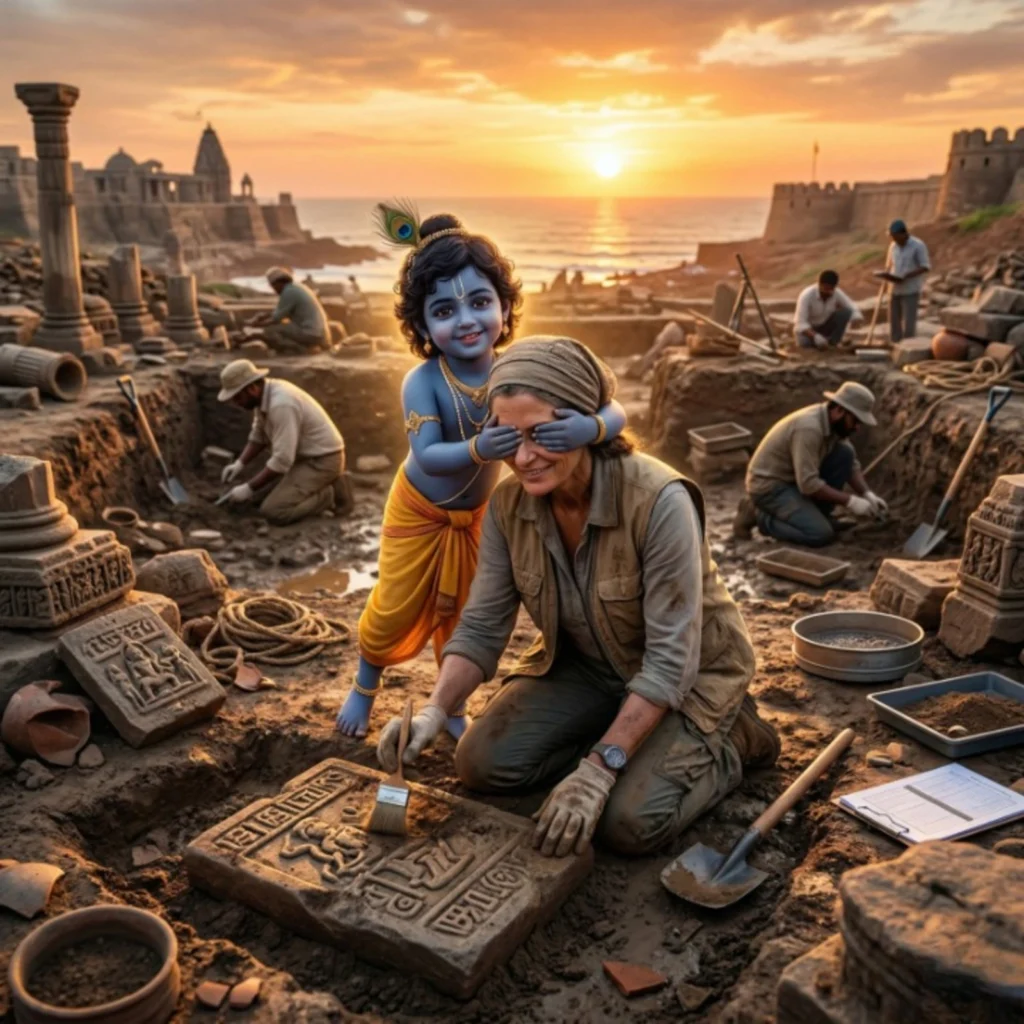
Of all the questions about Indian sacred narratives, this might be the most personal for millions:
Did Krishna really exist?
Not as metaphor. Not as symbol. Not as theological abstraction. But as a historical person who walked the earth, ruled Dwarka, advised Arjuna on the battlefield, and taught the Bhagavad Gita.
For devotees, the question feels unnecessary of course he existed. His presence is felt in worship, his teachings guide lives, his stories shape culture.
For skeptics, the question seems answered he’s mythology, not history. A literary character, not a historical figure.
But as I’ve explored throughout my work on challenging simplistic binaries, reality is more nuanced than “yes he existed” or “no he didn’t.”
The archaeological, astronomical, and textual evidence presents a complex picture not definitive proof, but not dismissive denial either.
Let me walk you through what we actually know.
Was Krishna a Real Person? What the Question Is Actually Asking
Before looking for the answer, it helps to look at the question. ‘Was krishna a real person?’ assumes a particular kind of answer is possible: a man named Krishna confirmable by the same methods used for Ashoka or Julius Caesar. This imports a Western historical framework into a tradition that organises its knowledge differently.
The Indic tradition distinguishes between what happened in the outer measurable world, recorded in Itihasa (thus it was), and what is cosmologically true, recorded in Puranas. Krishna exists in both registers simultaneously. The question of whether is krishna real therefore has two layers, and most debates collapse both into one.
What the Mahabharata Itself Says About Krishna
The Mahabharata is classified as Itihasa, the tradition’s own term for its historical narratives, distinguishing it from Purana and Katha. The text presents Krishna not as mythology in the dismissive sense but as a historical participant in events the tradition regards as having occurred.
It names specific kingdoms that can be cross-referenced: Mathura, Dwarka, Hastinapur, Kurukshetra. It records specific political alliances and astronomical events. Did Krishna exist historically? The tradition’s own classification of the text says yes, and the geographical evidence supports the claim that the ground the story stands on is real.
For the fuller argument about how the Indian tradition distinguishes mythology from history, this article covers the epistemological ground in full.
The Core Question: What Would “Proof” Look Like?
Before examining evidence, we need clarity about what we’re asking.
Three Different Questions
Question 1: Did someone named Krishna live in ancient India?
Question 2: Did Krishna do the things the Mahabharata describes?
Question 3: Was Krishna divine an avatar of Vishnu?
These are distinct questions requiring different kinds of evidence.
Modern historical methods can potentially address Questions 1 and 2 (with caveats). Question 3 is theological, not archaeological.
The Evidence Problem
No contemporary inscription says: “Krishna, son of Vasudeva, ruled Dwarka from year X to year Y.”
No ancient coin bears his image with his name.
No skeletal remains have been found labeled “Krishna.”
But this isn’t surprising. Most ancient figures lack such direct evidence. We accept their existence based on:
- Multiple independent textual references
- Geographical precision matching physical reality
- Cultural continuity of worship/memory
- Archaeological correlation with described events
By these standards, many historians conclude: A historical core likely underlies Krishna narratives, heavily elaborated over centuries.
Archaeological Evidence: What Has Been Found
The archaeological evidence of Krishna’s world comes primarily from two sites: Dwarka off the Gujarat coast, and Hastinapur in Uttar Pradesh. Both are named in the Mahabharata. Both have been formally excavated by Indian institutions with published findings. Did Krishna really exist? The evidence approaches this from three independent directions: textual, geographical, and archaeological.
Evidence 1: Underwater Dwarka – The Submerged City
This is the most dramatic archaeological find related to Krishna.
What the Texts Say
The Mahabharata explicitly describes:
“The ocean flooded over the city of the Vrishnis… Whatever portion of land was passed over, the ocean immediately flooded over with its waters.”
The Harivamsa (supplement to Mahabharata) describes Dwarka as:
“Built on submerged land” (2.55.778) “Released into the ocean” (2.58.34)
For centuries, this was dismissed as poetic metaphor.
The Discovery
In the 1980s-90s, marine archaeologist Dr. S.R. Rao led underwater expeditions off Gujarat’s coast near modern Dwarka.
What they found submerged in the Arabian Sea:
Massive structures:
- City walls (up to 6 meters thick)
- Fort bastions
- Harbor infrastructure
- Stone-cut slipways of varying widths
- Large door-socket
Artifacts:
- Stone anchors (triangular with three holes) same type used in Syria/Cyprus around 1500 BCE
- Distinctive pottery (Lustrous Red Ware)
- Three-headed conch seal matching Harivamsa description that “every citizen of Dwarka should carry such a seal”
- Copper utensils with Vedic Sanskrit inscriptions
Dating: Carbon-14 testing yielded dates around 1500 BCE (approximately 3500 years ago).
Dr. S.R. Rao’s Conclusion
In his book “The Lost City of Dwaraka” (1999):
“The discovery is an important landmark in the history of India. It has set to rest the doubts expressed by historians about the historicity of Mahabharata and the very existence of Dwarka city.”
Skeptical Counterpoints
Not all archaeologists agree on interpretation:
Dating debates: Some structures may be medieval (1000-1500 CE), not 1500 BCE Natural formations: Underwater geology can create structure-like appearances Multiple cities: Several settlements may have existed at this location across millennia Identification issues: Proving these are specifically Krishna’s Dwarka is difficult
As IndianYug analysis notes, some viral images claiming to show underwater Dwarka are actually Cleopatra’s palace in Alexandria, Egypt cautioning against uncritical acceptance of claims.
What Can We Honestly Conclude?
Established fact: A significant ancient city existed underwater where texts describe Dwarka.
Probable: This city was submerged by natural disaster (sea level rise, earthquake, tsunami).
Uncertain: Whether this specific city was ruled by a person named Krishna.
Important: The geographical precision is remarkable texts describe a submerged coastal city, and one exists exactly where predicted.
The Dwarka findings sit within a larger body of archaeological evidence of the Mahabharata war that covers multiple sites across North India.
Evidence 2: The Heliodorus Pillar – Non-Hindu Testimony
This is perhaps the strongest extra-textual evidence.
What It Is
In 113 BCE, a Greek ambassador named Heliodorus erected a pillar in Vidisha (Madhya Pradesh) with a Sanskrit inscription.
The inscription reads:
“This Garuda column of Vasudeva (Vishnu), the god of gods, was erected here by Heliodorus, a worshipper of Vishnu, the son of Dion, and an inhabitant of Taxila, who came as Greek ambassador from the Great King Antialkidas to King Kasiputra Bhagabhadra, the Savior, then reigning prosperously in the fourteenth year of his kingship.”
Why This Matters
1. Pre-Christian worship: A Greek worshipping Vishnu/Krishna in 113 BCE centuries before Christianity.
2. Vasudeva = Krishna: Vasudeva is Krishna’s patronymic (son of Vasudeva). In Vaishnava tradition, Vasudeva-Krishna are identical.
3. Cultural spread: Krishna worship had spread beyond India to attract foreign converts by 113 BCE.
4. Independent attestation: This isn’t Hindu text it’s Greek testimony on stone.
As scholar Thomas J. Hopkins notes:
“Heliodorus was presumably not the earliest Greek who was converted to Vaishnava devotional practices… Certainly there were numerous others including the king who sent him as an ambassador.”
What This Tells Us
By 113 BCE, Krishna worship was:
- Well-established enough to attract foreign devotees
- Centered on Vasudeva-Krishna as supreme deity
- Sufficiently prominent for diplomatic representatives to publicly declare affiliation
This doesn’t prove Krishna existed. But it proves Krishna traditions were ancient, widespread, and taken seriously by non-Hindus centuries before the Common Era.
Evidence 3: Astronomical Dating – When Did Krishna Live?
The Mahabharata contains precise astronomical descriptions. Modern software can calculate when those configurations actually occurred.
The Method
Texts describe:
- Planetary positions
- Lunar mansions (nakshatras)
- Eclipses
- Comet appearances
- Constellation alignments
Researcher Nilesh Oak used astronomical software (Voyager 4.5) to simulate ancient skies, matching textual descriptions to actual celestial events.
The Dates
Traditional calculation: 3102 BCE (based on Kali Yuga beginning)
Nilesh Oak’s research:
- Mahabharata War: 5561 BCE (based on 200+ astronomical observations)
- Dwarka submersion: 5525 BCE (36 years after war, as texts describe)
Conservative estimates: 1500-1000 BCE
The Problems
Multiple dates possible: Different verses yield different dates, suggesting:
- Compositional layers from different periods
- Symbolic rather than literal descriptions
- Copying errors over millennia
Precision vs. accuracy: Texts describe events precisely, but were these descriptions meant as exact historical markers or poetic/symbolic language?
Circular reasoning risk: Using texts to prove texts can be methodologically problematic.
What Can We Conclude?
Astronomical descriptions are remarkably detailed suggesting either: a) Eyewitness observation by knowledgeable astronomers, or b) Later sophisticated astronomical knowledge retrofitted into narratives
Multiple chronologies exist the “when” remains contested.
A historical core seems likely the precision suggests real events, even if dates are disputed.
Evidence 4: Archaeological Sites Matching Mahabharata Geography
As I detailed in my piece on Mahabharata evidence, dozens of sites match the epic’s geography.
Krishna-Related Sites
Modern Dwarka (on land):
- Copper inscription from 574 CE mentions Dwarka
- Archaeological Survey of India found settlement layers from 1st century BCE to 9th century CE
- Ancient temple foundations discovered
- Evidence of continuous habitation and worship
Mathura (Krishna’s birthplace):
- Ancient city with continuous occupation
- Vedic-era cultural layers
- References in multiple ancient texts
Bet Dwarka (island near Dwarka):
- Ancient harbor remains
- Temples on old foundations
- Artifacts from Mauryan era (300 BCE)
Prabhasa (where Krishna died):
- Ancient pilgrimage site
- Archaeological remains matching textual descriptions
The Pattern
Krishna narratives describe a coherent geography of Late Vedic/post-Vedic North India and Gujarat.
Archaeological evidence shows these weren’t invented locations real settlements existed where described, during plausible time periods.
Evidence 5: Textual Layers and Historical Memory
The Mahabharata isn’t one text it’s layers composed over centuries.
Core Historical Kernel
Scholars identify a historical core:
- Dynastic conflict in Kuru kingdom
- War at Kurukshetra
- Krishna as political figure/adviser
- Yadava kingdom in western India
Later Elaborations
Over centuries, additions included:
- Divine birth narratives
- Miraculous childhood stories
- Theological discourses (Bhagavad Gita likely later interpolation)
- Cosmic battle descriptions with divine weapons
What This Suggests
As I’ve discussed, sacred narratives preserve historical memory while adding religious/philosophical layers.
A plausible reconstruction:
- Historical figure named Krishna ruled a kingdom
- Involved in major political/military conflict
- Over centuries, became deified
- Stories expanded with theological significance
- Final text compiled ~400 BCE-400 CE
This is normal for ancient figures who become religious icons (compare: Buddha, Jesus, Abraham).
The Honest Assessment: What Can We Actually Say?
After reviewing all evidence, here’s what historians and archaeologists generally conclude:
Very Likely True
1. Krishna worship is ancient (at least 2,300 years old Heliodorus pillar)
2. A kingdom existed near Dwarka (underwater archaeology confirms this)
3. Coastal submersion occurred (geological reality)
4. Mahabharata describes real geography (dozens of sites match descriptions)
5. The text preserves historical memory (mixed with theology and elaboration)
Probably True
1. A historical figure named Krishna existed (multiple independent traditions, worship continuity, geographical precision)
2. He ruled a kingdom in western India (Dwarka region)
3. He was involved in significant political events (preserved as Mahabharata war)
4. He lived sometime between 3500-1000 BCE (exact dating remains contested)
Uncertain
1. Specific biographical details (birth in prison, childhood miracles, etc.)
2. Divine nature (theological claim, not historically testable)
3. Authorship of Bhagavad Gita (likely composed/attributed later)
4. Supernatural events (divine weapons, cosmic forms unverifiable)
What We Can’t Prove
That every detail happened as described
That Krishna performed miracles
That he was literally Vishnu incarnate
The exact year he lived
That he personally spoke the Gita on the battlefield
Why the Question Matters
This isn’t just academic.
For Believers
Archaeological evidence validates that traditions preserve real history Krishna isn’t “just mythology” dismissed by colonial scholars.
For Skeptics
The evidence prevents simplistic dismissal “all myth” doesn’t fit the data. Something historical underlies these narratives.
For Everyone
Understanding the category of Itihasa sacred narrative that preserves historical memory while serving religious purposes helps us engage texts honestly.
Neither naive literalism (“every word is historical fact”) nor dismissive skepticism (“it’s all made up”) does justice to the evidence.
What Evidence Can Tell You, And What It Cannot
Is Krishna real or myth? The framing assumes a binary the tradition itself does not use. Archaeological evidence can confirm that places exist and civilisations flourished. It cannot confirm the biography of a specific individual from several thousand years ago without detailed contemporaneous corroboration.
This is not unique to Krishna’s case. We cannot archaeologically prove Homer, Socrates, or the historical Buddha from artefacts alone. Applying the same standard consistently to the Indic tradition produces a more honest answer than either extreme: the geographical and historical ground is real. What happens on that ground is what the tradition’s own literature describes.
Conclusion: Beyond “Real or Fake”
So: Did Krishna really exist?
The most honest answer:
A historical figure named Krishna very likely existed, ruled a kingdom in western India, was involved in major political/military events, and became the focus of devotional traditions that elaborated his life story with theological significance over centuries.
The underwater city, ancient worship, geographical precision, and textual layers all support this.
What we can’t prove: Every biographical detail, supernatural claims, or divine nature.
But this is true for most ancient religious figures. We accept Buddha, Jesus, Muhammad existed on similar evidence levels.
The real question isn’t “real or fake?” but “what kind of real?“
Krishna is historically real as:
- Ancient historical figure
- Religious tradition spanning 2,300+ years
- Cultural force shaping civilization
- Devotional focus for billions
Whether he was literally divine? That’s theology, not archaeology.
But the person? The kingdom? The traditions preserving memory of him?
Those are as real as ancient history gets.
The cosmological tradition Krishna inhabits an,d Mahadevi and the tradition Krishna’s world belongs to, is explored separately.
Frequently Asked Questions
The Mahabharata, the primary text recording Krishna’s role, is classified in the Indic tradition as Itihasa, meaning historical narrative. The text is geographically grounded and names kingdoms, rivers, and cities that can be cross-referenced with known locations. Archaeological findings at Dwarka and Hastinapur support parts of this geographical setting. However, current evidence cannot definitively establish whether Krishna as described was one historical individual or a figure whose biography accumulated multiple historical memories over time. The available evidence supports treating the tradition as historically grounded, while the full details of Krishna’s life remain beyond conclusive archaeological verification.
The evidence is cumulative rather than forensic. It includes the geographically detailed narratives of the Mahabharata and Harivamsa, submerged structures and maritime remains found near Dwarka, Painted Grey Ware occupation layers and a flood layer at Hastinapur, the long continuity of Krishna worship, and the Heliodorus Pillar inscription from 113 BCE referring to devotion to Vasudeva. Jain and Buddhist traditions also acknowledge a figure consistent with Krishna. Together, these sources establish a strong historical and cultural setting, but they do not provide direct physical proof of one individual’s complete biography.
Underwater investigations off the Dwarka coast in Gujarat found submerged stone structures, walls, harbour-related remains, pottery, and stone anchors. Some reported dates for material from the wider site range between approximately 1500 and 3000 BCE, although interpretations and dating remain debated. The anchors and coastal remains indicate a significant maritime settlement. These discoveries are consistent with the tradition’s description of Dwarka as an important coastal city that was later affected by the sea. They confirm an ancient settlement in the region, but they do not by themselves prove Krishna’s personal biography.
There is no universally accepted date for Krishna’s lifetime. Traditional Hindu chronology places the Mahabharata war around 3102 BCE. Astronomical interpretations of planetary positions described in the epic have produced estimates ranging from approximately 3067 BCE to 1478 BCE, while some researchers propose still earlier dates. Archaeological evidence from sites associated with the tradition is generally dated more conservatively. Because the methods and assumptions differ, no single date is accepted by all historians, archaeologists, and traditional scholars.
The Heliodorus Pillar is a stone column erected around 113 BCE by Heliodorus, a Greek ambassador in central India. Its inscription identifies him as a devotee of Vasudeva, a name closely associated with Krishna. The pillar is important because it independently confirms that Vasudeva-Krishna devotion was already well established by that period and had attracted followers beyond local Indian communities. It does not prove the details of Krishna’s lifetime, but it provides strong evidence for the antiquity and historical reach of his worship.
The Bhagavad Gita is presented within the Mahabharata as a dialogue between Krishna and Arjuna. Historical methods cannot determine whether the surviving text records a verbatim conversation spoken by a historical Krishna. Many scholars consider it a philosophical work that was composed or refined over time within the larger epic tradition. Its authority therefore does not depend solely on proving a word-for-word historical transcript. Its lasting importance comes from its teachings on dharma, action, devotion, knowledge, and the nature of reality.
Historians separate claims that can be examined through texts, archaeology, geography, and inscriptions from theological claims based on faith and spiritual interpretation. A historical Krishna may have been an influential leader, teacher, or central figure remembered within ancient communities. The theological Krishna is understood as an avatar of Vishnu and a divine manifestation with cosmic significance. Supernatural events cannot be tested through ordinary historical methods, but that does not make the entire tradition historically meaningless. The figure known today may preserve both historical memory and centuries of philosophical and devotional development.
Beyond historical debate, Krishna represents wisdom, dharma, devotion, compassion, leadership, and the integration of purposeful action with inner awareness. In the Bhagavad Gita, he guides Arjuna through questions of duty, moral conflict, consciousness, and liberation. In devotional traditions, Krishna also represents divine love and a personal relationship with the sacred. For millions of people, he is not only a subject of historical inquiry but a living spiritual presence whose influence continues across philosophy, music, art, literature, and daily worship.
Continue Your Journey

About the Author
Priyanka Sharma Kaintura
A mythology writer, author, and speaker exploring how ancient texts and modern archaeology inform each other. Her books include Mahadevi: The Unseen Truth Behind Existence and My Jiffies: Narration of Moments, Unadulterated and Unpackaged.


