What an ancient account of Devas, Asuras and the emergence of Lakshmi tells us about competition, cooperation and the creation of wealth.
Every Diwali, millions of homes and businesses welcome Lakshmi, the goddess of wealth, fortune and prosperity. We invoke her blessings, illuminate our surroundings and celebrate the promise of abundance. Yet there is something extraordinary about the circumstances of her emergence that deserves as much attention as the goddess herself.
Lakshmi emerged from the Samudra Manthana, the great churning of the cosmic ocean. And the churning was accomplished not by the Devas alone, but through an unlikely collaboration between the Devas and their perennial adversaries, the Asuras.
Why would prosperity require the participation of two opposing forces? And why could neither accomplish the task independently?
The answer offers an interesting way to examine how wealth is created, distributed and sustained, even in the modern economy.
Were the Asuras Really the Villains?
In popular retellings of our Pauranic narratives, Devas are frequently presented as divine beings representing good, and Asuras as demonic beings representing evil. But this convenient distinction does little justice to the complexity of their respective roles or their relationship with one another.
For one, they share a common ancestry. According to the Puranas, Sage Kashyapa married several daughters of Daksha Prajapati. Among them were Aditi, Diti and Danu. The Adityas also called Devas, including Indra, descended from Aditi; the Daityas from Diti; and the Danavas from Danu. The latter two lineages are among those broadly identified as Asuras. Therefore, many of the Devas and Asuras who repeatedly confront one another belong to the same extended family.
Their rivalry is persistent, but the Pauranic accounts do not always portray either side as morally uncomplicated. Indra’s arrogance repeatedly lands him in trouble. Prahlada, born into an Asura lineage, is celebrated for his unwavering devotion to Vishnu. His grandson Mahabali is remembered for his generosity and steadfastness. Clearly, virtue and vice do not follow a simple division between the two.
The Devas have Brihaspati as their guru, while the Asuras are guided by Shukracharya. Both possess knowledge, ambition and extraordinary abilities. Yet their approaches to power and possession frequently bring them into conflict.
In my book, Mahadevi – The Unseen Truth Behind Existence, I explored this relationship through another lens – the Asuras as forces of intuition, passion and preservation, and the Devas as forces of reason, acquisition and productive activity.
Consider the location traditionally associated with the Asuras – Patala Loka, the subterranean realms. Much of what makes human prosperity possible also lies beneath the earth’s surface. Minerals, metals, fossil fuels and precious stones remain concealed until some force brings them into productive use. Even the seed, before it becomes a crop, must surrender the security of the soil.
Within this interpretation, the Asuras hold and guard resources, reluctant to relinquish what lies within their domain. The Devas strive to extract, transform and put those resources to use. The former resist their release; the latter persist in seeking them.
It is this struggle that makes wealth available to the world. Neither force is redundant.
This is, of course, a philosophical reading of the narrative, not a literal economic classification prescribed by the Puranas. But it raises an intriguing question – can wealth be created without the interaction of forces that appear to work against one another?
Why the Ocean Needed Both Sides
The circumstances leading to the Samudra Manthana are revealing.
Indra, the king of the Devas, had incurred the wrath of Sage Durvasa through an act of disrespect. The resulting curse deprived the Devas of their strength and fortune, leaving them vulnerable to the Asuras.
They turned to Vishnu for help. His solution was not another battle. Instead, he advised the Devas to seek the cooperation of their adversaries in churning the Ksheer Sagar, the ocean of milk, for Amrita, the nectar of immortality.
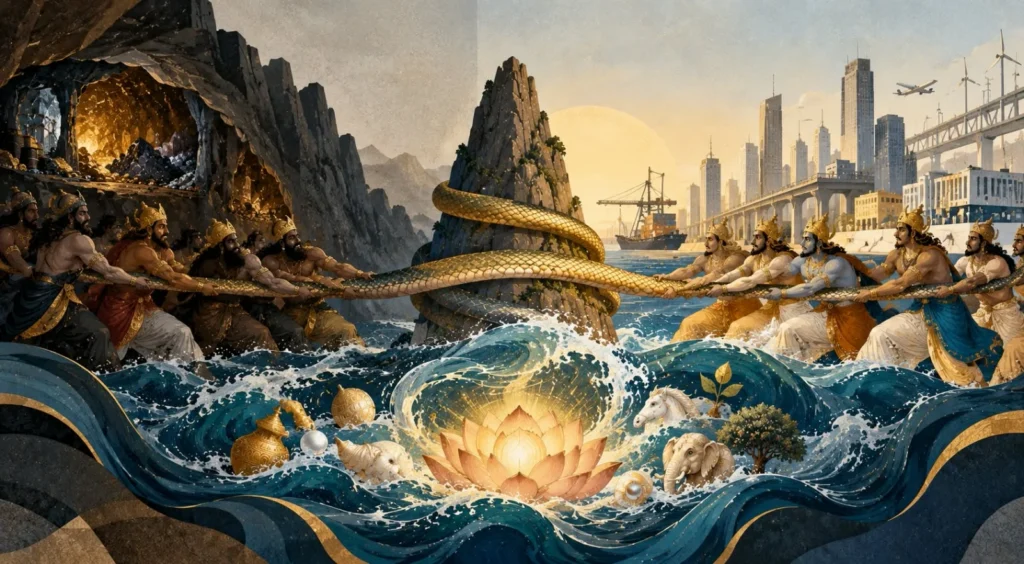
Mount Mandara became the churning rod, the serpent Vasuki served as the rope, and Vishnu, in his Kurma incarnation, supported the mountain when it began to sink.
The Devas and Asuras pulled from opposite ends. Here lies the remarkable feature of the episode. The same adversaries who had fought for power and possession now had to work towards a common undertaking. Neither side could produce the desired result alone. They were competitors in ambition, but partners in execution
And the churning did not immediately yield the treasures they sought. It first released Halahala, the terrible poison that threatened to consume existence. Shiva intervened to contain it. Only as the churning continued did the ocean reveal its extraordinary riches, including Lakshmi, who then chose Vishnu as her consort.
The sequence matters. Prosperity did not emerge from stillness, possession or an effortless victory. It followed an arduous process involving rivalry, cooperation, risk, intervention and sustained effort.
The Business of Opposing Forces
Modern business operates through comparable tensions.
Competition encourages companies to improve products, discover efficiencies and challenge established practices. Cooperation, meanwhile, allows them to build the infrastructure, standards and networks without which entire industries would struggle to function.
Consider digital payments. Banks, payment companies, merchants and technology providers compete for customers, transactions and market share. Yet India’s Unified Payments Interface depends on common protocols, interoperability and a shared institutional framework. The participants may compete vigorously for customers, but the underlying system requires coordination.
It illustrates a simple principle – competition can create value within a market, while cooperation can help create the market itself.
And this is hardly confined to competing companies.
Investors and entrepreneurs need one another, although their priorities may differ considerably. Investors seek returns and financial discipline; entrepreneurs need capital, freedom to experiment and time to build. Employers depend on the skills and commitment of employees, who in turn seek fair compensation for their skills, security that encourages commitment and opportunities to grow.
Producers need distributors to reach markets, while distributors demand reliable products and viable margins to build those markets. Innovators push the boundaries of what is possible; regulators must consider safety, accountability and the public interest. Even buyers and sellers approach a transaction from opposite directions, one seeking value for money, the other a worthwhile return.
The interests are not always aligned. They can produce difficult negotiations, disagreements and occasionally confrontation. But they also compel each side to recognise constraints, improve its proposition and arrive at arrangements that make economic activity possible.
An economy in which everyone seeks only to preserve an existing advantage risks stagnation. And one in which everyone pursues expansion without restraint risks instability.
Neither preservation nor disruption is sufficient by itself. The challenge lies in making their interaction productive.
Possessing Riches Is Not the Same as Creating Wealth
There is another distinction in the Samudra Manthana that deserves attention. The treasures existed within the ocean before the churning began. Yet their existence alone did not make them available or useful to the wider creation.
Something had to happen to bring them forth.
In the interpretation explored earlier, the Asuras’ instinct to retain resources and the Devas’ determination to put them to productive use create the very tension through which dormant riches become wealth.
This distinction lies at the heart of how economies create wealth.
A mineral deposit has potential value, but converting it into a useful material requires technology, labour, capital, infrastructure and enterprise. Agricultural land may possess enormous productive capacity, but its output depends on cultivation, water, knowledge and access to markets. An invention may be ingenious, but it creates wider economic value only when it can be developed, produced and adopted.
Resources are not the same as prosperity. Nor is their mere extraction sufficient to guarantee it. Similarly, the pursuit of wealth cannot ignore the limits of the resources it depends on. Excessive extraction, the depletion of natural reserves, expansion without institutional capacity, or short-term gains at the expense of long-term viability can undermine the very conditions that make future prosperity possible.
So, preservation without productive use can leave potential unrealised and production without preservation can exhaust the source of future wealth. The opposing forces must therefore do more than struggle. They must arrive at a workable relationship.
A successful economy needs those who discover and create, those who conserve and protect, those who challenge established arrangements, and those who ensure that change does not destroy what remains valuable.
The question is not which force should prevail permanently, but how their competing purposes can produce something neither could achieve independently.
And Who Bears the Poison?
The emergence of Halahala introduces a more uncomfortable dimension to this discussion. The churning promised extraordinary rewards. But before those rewards appeared, it produced a danger that neither the Devas nor the Asuras could contain.
Shiva had to intervene and contain the poison.
There is a contemporary business question concealed within that episode – when economic activity generates both wealth and harm, who receives the benefits, and who bears the consequences?
Industries create employment, innovation, infrastructure and wealth. They can also generate pollution, waste, unsafe working conditions and pressure on natural resources. These outcomes vary considerably across sectors and businesses, but the underlying question remains important.
If the rewards of enterprise accrue to some while its costs are transferred to others, can the resulting prosperity truly be considered sustainable? The story does not offer a ready-made economic policy. Nor should Shiva’s intervention be romanticised into an expectation that someone else will always absorb the consequences of collective ambition.
Rather, it reminds us that the creation of wealth and the management of its consequences are inseparable responsibilities. The poison, too, is a product of the churning.
The Paradox of Prosperity
There is one more uncomfortable aspect of the Samudra Manthana that we should not overlook.
The Asuras contributed their strength and effort to the churning, yet they did not receive the Amrita they had helped produce. In the Bhagavata Purana, Vishnu assumes the form of Mohini and ensures that the nectar is distributed to the Devas instead.
Viewed through the lens of economic cooperation, this raises a difficult question – does participation in the creation of wealth necessarily ensure a fair share in its rewards? Not always. In business, value is often created by many participants, but the ability to capture it depends on factors beyond contribution alone. Ownership, bargaining power, access to markets and control over decisions can determine who ultimately benefits.
The Samudra Manthana is therefore not a simple celebration of cooperation. The Devas and Asuras never abandoned their rivalry. They came together because both expected to gain from the undertaking, and neither could accomplish it alone. Their interests converged, even as their ambitions remained opposed.
That complexity is precisely what makes the narrative worth revisiting. Prosperity does not automatically make its participants generous, ethical or wise. And cooperation in creating wealth does not guarantee fairness in sharing it.
And herein lies perhaps the most fascinating economic insight of the story.
Both sides were seeking Amrita. Neither had undertaken the churning specifically to bring forth Lakshmi. Yet their combined effort produced something whose significance extended far beyond their immediate ambitions.
This Diwali, as we welcome Lakshmi, perhaps we should remember that she emerged not from shared ideals or generosity, but from the pursuit of competing ambitions. The Devas and Asuras sought Amrita for themselves. What their combined effort brought forth was prosperity for the wider world.
This article is also available in Hindi on BW Hindi.
Read the Hindi version here: समुद्र मंथन का अर्थशास्त्र: समृद्धि के लिए विरोधी शक्तियों की जरूरत क्यों है
Continue Your Journey

About the Author
Priyanka Sharma Kaintura
A mythology writer, author, and speaker exploring how ancient texts and modern archaeology inform each other. Her books include Mahadevi: The Unseen Truth Behind Existence and My Jiffies: Narration of Moments, Unadulterated and Unpackaged.